When your back suddenly starts hurting, one of the first questions is often:Should you use heat or ice for back pain? A cold pack may seem appropriate after an injury, while a heating pad can feel soothing when your muscles are tight or stiff. Choosing between them can be confusing because both are commonly recommended, yet they work differently and are not equally useful in every situation.
The good news is that neither choice has to be permanent. Heat and ice are generally used to provide temporary symptom relief, not to correct the underlying cause of back pain. If one makes your symptoms more comfortable and does not cause skin irritation or increased pain, that response can help guide your choice.
This guide explains when heat may be more useful than ice, when cold may make more sense, how long to use either option, which method is supported by research, common mistakes to avoid, and when back pain should be evaluated rather than treated only with heat or ice.
Heat or ice for back pain: which is better?
Neither heat nor ice is universally better. The more useful option depends on the type and timing of your symptoms, how your body responds, and whether there is a reason to avoid one approach.
Heat is often more comfortable for stiffness, muscle tightness, and chronic or subacute symptoms. Cold may feel better after certain acute injuries or when the area feels hot, swollen, or irritated.
However, the evidence does not show that everyone with back pain needs to choose one method over the other.
A clinical guideline for acute and subacute low back pain identified superficial heat as a reasonable initial non-drug treatment. Evidence for cold treatment specifically for low back pain is less established, so ice should not automatically be considered superior simply because pain started recently.
Quick comparison
| Heat | Ice |
|---|---|
| Often feels soothing for stiffness or muscle tightness | May temporarily numb or reduce pain sensation |
| Can make movement feel more comfortable | May be useful after some acute injuries |
| Commonly used with chronic or subacute discomfort | Can feel helpful when an area feels irritated |
| May promote relaxation | May temporarily reduce sensitivity |
| Can cause burns if excessively hot | Can cause skin injury if applied directly or too long |
The practical question is not simply which treatment is theoretically stronger. Ask: Which option makes your symptoms more comfortable without causing additional problems?
When should you use heat for back pain?
Heat may be useful when your back feels stiff, tight, achy, or uncomfortable after periods of inactivity.
Some people find that warmth makes movement easier, particularly when muscle tension is contributing to discomfort. Heat can also be relaxing before activity or bedtime.
For acute low back pain, clinical guidance has supported superficial heat as an initial non-drug option. Earlier trials of heat wraps found short-term improvements in pain and function, although newer research has produced more mixed results.
Heat should therefore be viewed as a symptom-management tool rather than a treatment that repairs injured tissue.
Heat may be worth trying when:
- Your back feels stiff after sitting or sleeping.
- Muscle tightness is prominent.
- Warmth makes movement more comfortable.
- You have recurring or persistent aching.
- You want temporary relief before gentle activity.
If heat makes your symptoms worse, stop using it. The separate guide on when heat can worsen back pain explains situations where warmth may not be a good choice.
When should you use ice for back pain?
Ice may be worth trying when back pain follows a recent injury or sudden flare, particularly if cold feels soothing.
People often associate ice with inflammation, but back pain is not automatically an inflammatory injury. A muscle strain, joint irritation, or nonspecific low back pain may respond differently from one person to another.
Cold can temporarily reduce the sensation of pain by numbing the area. That does not necessarily mean it is accelerating tissue healing.
Ice may be worth trying when:
- Pain began after a recent injury.
- The area feels irritated after an activity.
- Cold provides noticeable temporary relief.
- Heat makes your symptoms feel worse.
- You prefer cold during the first part of an acute flare.
Do not place ice directly against bare skin.
How long should you use heat or ice?
There is no single duration that works for everyone, but short applications are generally safer than prolonged exposure.
A practical approach is to use a wrapped cold pack or comfortably warm heat source for approximately 15–20 minutes at a time, then remove it and allow your skin to return to its normal temperature.
You should not fall asleep while using a heating pad or leave an ice pack against your skin for an extended period.
| Method | Practical starting approach | Important safety point |
|---|---|---|
| Heat pack | About 15–20 minutes | Warm, not excessively hot |
| Heating pad | Short supervised sessions | Do not sleep with it |
| Cold pack | About 15–20 minutes | Wrap it in cloth |
| Ice-filled bag | Short applications | Never apply directly to skin |
| Alternating heat/cold | Only if each feels comfortable | Avoid continuous exposure |
Stop immediately if your skin becomes painful, excessively red, pale, numb, blistered, or otherwise irritated.
How should you apply heat safely?
Use a comfortably warm—not extremely hot—source.
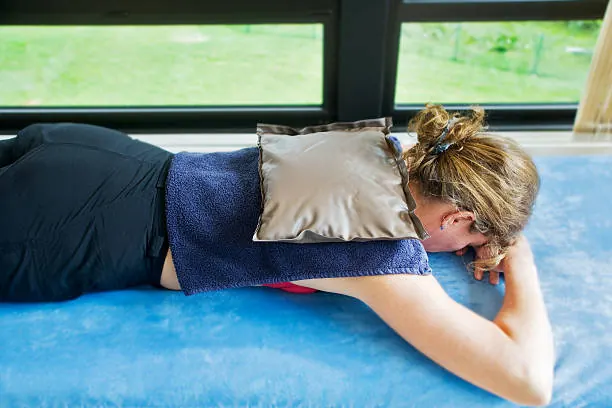
A heating pad, warm compress, or other controlled heat source can be placed over clothing or a protective layer. Check your skin periodically.
People with reduced sensation need particular caution because they may not recognize excessive heat until a burn has occurred.
Heat should also not be used as a way to push through severe pain. If warmth temporarily masks symptoms and encourages you to perform an activity that clearly aggravates an injury, it may do more harm than good.
How should you apply ice safely?
Never place ice directly against your skin.
Wrap an ice pack in a thin cloth or towel before applying it. Keep the application relatively brief and inspect the skin afterward.
Stop if the skin becomes unusually painful, very pale, blistered, or persistently numb.
People with circulation problems or impaired sensation should ask a healthcare professional before using cold therapy.
Is heat or ice better for a pulled back muscle?
If your back pain began after lifting, twisting, exercising, or another activity, either heat or cold may provide temporary comfort.
During the first part of an acute injury, some people prefer cold because it reduces pain sensation. Others find heat more comfortable because it decreases the feeling of tightness.
There is no reliable rule that says every pulled muscle must be treated with ice or that heat should always be avoided.
The severity of the injury matters more than the choice between two home treatments. If you cannot move normally, have significant weakness, or developed severe pain after trauma, medical evaluation may be more appropriate.
Is heat or ice better for chronic back pain?
For persistent or recurrent back pain, heat is often more comfortable than ice, particularly when stiffness and muscle tightness are prominent.
Heat has been studied more extensively as a non-drug treatment for low back pain. A guideline for acute and subacute low back pain found moderate-quality evidence supporting superficial heat, particularly heat wraps.
However, this does not mean heat will work for everyone. A 2026 randomized trial involving 99 adults found that a heat wrap, either alone or combined with exercise, was not statistically superior to sham heat for disability after one week. This illustrates an important point: heat can provide subjective comfort without necessarily producing a large change in the underlying course of back pain.
Does heat actually help back pain?
Heat can provide short-term relief for some people, especially when stiffness or muscle tightness is present.
An older randomized trial involving 371 people with low back pain reported short-term improvements in pain, stiffness, flexibility, and disability with heat-wrap treatment.
More recent evidence is less consistent. A 2025 overview examining 31 Cochrane reviews and 644 trials involving more than 97,000 adults with low back pain found substantial variation across non-drug treatments.
The evidence therefore supports heat as a reasonable comfort measure, but not as a guaranteed solution.
Does ice actually help back pain?
Ice can temporarily reduce pain sensation, but evidence specifically supporting cold therapy for nonspecific low back pain is less convincing than evidence supporting superficial heat.
That does not mean ice is useless. A person with a recent injury may find cold more comfortable, and temporary pain reduction can make gentle movement easier.
The important distinction is between symptom relief and recovery. Feeling temporarily better after applying ice does not necessarily mean the underlying problem has healed.
Can you alternate heat and ice?
You can sometimes alternate them if both feel comfortable, but there is no requirement to use both.
For example, someone might prefer cold immediately after an aggravating activity and warmth later when stiffness becomes more noticeable. Another person may find that switching between the two provides no additional benefit.
If alternating treatments causes skin irritation or makes your symptoms fluctuate unpredictably, stop and use whichever approach is better tolerated.
A simple decision guide
| Your main symptom | First option to consider | Why |
|---|---|---|
| Stiffness after inactivity | Heat | May make movement more comfortable |
| Muscle tightness | Heat | Often feels relaxing |
| Recent minor injury | Ice or heat based on response | Both may provide temporary relief |
| Cold feels better | Ice | Individual response matters |
| Heat increases discomfort | Avoid heat | Comfort response is important |
| Persistent nonspecific aching | Heat may be reasonable | Evidence is more established than for cold |
This is a practical guide, not a diagnostic tool. The underlying cause of back pain still matters.
What should you do after using heat or ice?
The most useful next step is usually comfortable movement rather than prolonged rest.
If symptoms allow, stand up, walk briefly, or perform gentle movements. The aim is to avoid turning temporary pain relief into prolonged inactivity.
Research on low back pain generally supports remaining active as tolerated rather than using prolonged bed rest.
For broader self-care strategies, see how to relieve back pain at home.
If you are trying to build a longer-term recovery plan, information about how to get rid of back pain can help you look beyond temporary temperature therapy.
Should you use heat or ice before exercise?
Either may be appropriate depending on your symptoms, but neither should be used to hide pain so that you can perform an activity that would otherwise be too painful.
If stiffness is preventing comfortable movement, warmth may help you feel looser before gentle activity. If a recent flare feels irritated and cold provides relief, a short cold application may be preferable.
Exercise itself can be an important component of recovery. For guidance on movement, see exercises for lower back pain.
Stop an exercise that produces significant or progressively worsening pain rather than relying on heat or ice to allow you to continue.
What if back pain is worse at night?
If you mainly need heat or ice because your symptoms interfere with sleep, consider the broader sleep environment.
Nighttime back pain can have several possible causes, including prolonged positioning, an existing back problem, and an uncomfortable sleep surface. Learn more about why back pain gets worse at night rather than assuming temperature therapy is the whole solution.
Your sleeping position can also influence comfort. If needed, review how to sleep with lower back pain.
If your mattress is sagging or consistently uncomfortable, consider choosing a mattress for back pain.
When should you avoid treating back pain only with heat or ice?
Temperature therapy is not appropriate as a substitute for evaluation when symptoms suggest a potentially serious problem.
You should seek medical advice when pain is persistent or worsening, follows a significant injury, or is associated with neurological symptoms or unexplained systemic symptoms.
Certain symptom patterns also deserve specific consideration. For example, lower back pain on the right side can have several possible causes, while pain in the lower left back in women may sometimes involve factors outside the spine.
Back discomfort can also occur with abdominal or digestive symptoms. Constipation-related back pain is one example of why the source of discomfort should not automatically be assumed to be a muscle.
Heat and ice do not treat every cause of back pain
The temperature of a treatment does not determine the cause of your symptoms.
Back pain can result from many different problems, and some causes require treatments that have nothing to do with heat or cold. A general overview of the possible causes of back pain can help explain why symptoms need to be considered in context.
If pain is associated with unusual symptoms, the location and accompanying features matter. For example, discomfort around the ribs may be different from ordinary lower back pain. You can learn more about rib and back pain when symptoms extend beyond the lumbar region.
Warning signs: when heat or ice is not enough
Symptoms that can often be monitored
Mild back pain without neurological or systemic warning signs can often be monitored while you use reasonable self-care. Temporary improvement with heat or ice is reassuring only in the limited sense that the treatment is providing comfort; it does not establish the cause.
Symptoms needing medical evaluation
Arrange medical evaluation if pain persists, repeatedly returns without an obvious explanation, progressively worsens, substantially interferes with normal activities, or does not improve as expected.
Pain that occurs after significant trauma should also be assessed appropriately.
Symptoms requiring urgent or emergency care
Seek urgent or emergency care for new bladder or bowel control problems, numbness around the groin or saddle area, significant or progressive weakness, severe neurological symptoms, or severe pain following major trauma.
If back pain occurs with significant chest symptoms, do not assume that the pain is coming from your spine. Information about back-related chest pain may help explain musculoskeletal possibilities, but new or unexplained chest pain can require urgent assessment.
Common mistakes when using heat or ice
Several simple mistakes can turn a potentially useful comfort measure into a source of injury.
Using excessive heat: Hotter is not better. Very high temperatures can burn the skin.
Applying ice directly: Direct contact can damage skin. Always use a protective layer.
Using either treatment for too long: Prolonged exposure increases the risk of skin injury without necessarily producing additional pain relief.
Sleeping with a heating pad: Falling asleep while using heat can result in burns because you may not notice excessive temperature.
Ignoring worsening symptoms: If pain is getting progressively worse, repeatedly applying heat or ice may delay appropriate evaluation.
Using temperature therapy to push through pain: Temporary numbness or warmth should not be used to override significant pain during exercise or physical activity.
How should you choose between heat and ice?
A simple approach is:
- Identify what the pain feels like. Stiffness and tightness may favor heat; recent injury-related irritation may make cold worth trying.
- Consider timing. A sudden flare and long-standing stiffness may respond differently.
- Try one option safely. Use a short, supervised application.
- Check your response. Continue only if it makes you more comfortable without irritating your skin or worsening symptoms.
- Return to appropriate activity. Temperature therapy should support movement and comfort rather than replace recovery.
- Reassess persistent symptoms. If pain continues or develops warning signs, seek medical evaluation.
Frequently Asked Questions
1. Is heat or ice better for lower back pain?
Neither is universally better. Heat is often a reasonable choice for stiffness and muscle tightness, while cold may be preferred after some recent injuries or when it provides better temporary pain relief.
2. Should I use ice immediately after hurting my back?
Ice can be tried after a recent minor injury if it feels helpful, but it is not mandatory. A short, protected application is safer than prolonged direct exposure.
3. How long should I leave ice on my back?
A practical starting point is about 15–20 minutes with a cloth barrier between the cold source and your skin. Stop sooner if you develop significant numbness, pain, skin discoloration, or irritation.
4. How long should I use a heating pad for back pain?
Short sessions of roughly 15–20 minutes are a reasonable starting point. Use comfortably warm temperatures, monitor your skin, and never sleep with a heating pad operating.
5. Can heat make back pain worse?
Yes. Some people feel worse with heat, and excessive heat can also irritate or burn the skin. Stop using it if warmth clearly increases your symptoms.
6. Is heat good for chronic lower back pain?
Heat may provide short-term comfort for chronic or recurring back pain, particularly when stiffness is prominent. It should be considered one part of symptom management rather than a treatment that fixes the underlying cause.
7. Can I alternate heat and ice for back pain?
You can alternate them if both are comfortable and used safely, but there is no requirement to do so. If switching between them does not improve your symptoms, there is little reason to continue.
8. Should I use heat or ice before bed?
If stiffness or muscle tightness is interfering with comfort, heat may be soothing before bed. If you prefer cold and it provides temporary relief, a brief cold application may also be reasonable.
9. Should I use heat or ice before exercising with back pain?
Either may be used for comfort depending on your symptoms, but neither should be used to mask significant pain so you can exercise through an injury. Exercise should remain comfortable and appropriate for your condition.
10. When should I stop using heat or ice and see a doctor?
Seek medical evaluation when back pain is persistent, worsening, severe, follows significant trauma, or occurs with concerning neurological or systemic symptoms. New bladder or bowel dysfunction, saddle-area numbness, or significant weakness requires urgent attention.
Conclusion
When deciding between heat or ice for back pain, there is no universal winner. Heat is often a practical option for stiffness and muscle tightness, while ice may provide temporary relief after some recent injuries or when cold feels more comfortable.
Use either method briefly, protect your skin, avoid extreme temperatures, and treat temperature therapy as a comfort measure rather than a cure. Most importantly, do not allow temporary relief to distract you from symptoms that require medical evaluation.
If your back pain is uncomplicated, heat or ice can be one part of a broader plan that includes appropriate movement, sleep support, and gradual return to normal activities. If symptoms persist, worsen, or come with warning signs, focus on identifying the underlying problem rather than repeatedly switching between hot and cold.
Disclaimer: This article is provided for educational and informational purposes only. It is not a substitute for professional medical advice, diagnosis, or treatment