
Finding a comfortable sleeping position can be surprisingly difficult when your lower back hurts. You may fall asleep comfortably but wake after a few hours with stiffness, aching, or a sharp increase in pain when you turn over. Even small changes in how your hips, knees, shoulders, and spine are supported can affect how comfortable you feel through the night.
There is no single sleeping position that works for everyone with lower back pain. A position that feels good for one person may increase pressure or discomfort for another, and changing positions during the night is normal. The goal is not to keep your spine perfectly still but to find a position that reduces aggravating pressure, allows comfortable breathing and movement, and helps you sleep.
This guide explains the best sleeping positions for lower back pain, how to use pillows for support, whether side or back sleeping is better, what to do if you sleep on your stomach, how your mattress can affect comfort, and which symptoms should not simply be blamed on your sleeping position.
What is the best sleeping position for lower back pain?
For many people, sleeping on the back or side with appropriate support is a reasonable starting point. Back sleeping can allow the spine to remain relatively neutral, while side sleeping may be comfortable when the hips and spine are adequately supported.
A 2025 systematic review examining six observational studies found that supine, or back, sleeping was generally associated with better spinal alignment, while supportive side sleeping could also be beneficial. Prone, or stomach, sleeping was associated with more lumbar strain in the studies reviewed. However, the evidence was limited and largely observational, so it does not prove that one position is universally best.
In practice, comfort and symptom response matter. If a position allows you to sleep without substantially increasing your pain, there is usually no need to force yourself into a different position simply because it is considered theoretically better.
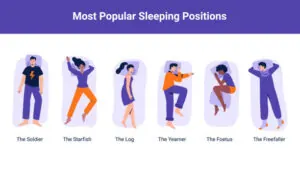
Quick comparison of sleeping positions
| Sleeping position | Potential advantage | Possible drawback | Useful adjustment |
|---|---|---|---|
| On your back | Can support relatively neutral spinal alignment | Lower back may feel uncomfortable for some people | Place a pillow under the knees |
| On your side | Can reduce pressure for some sleepers | Hips or spine may rotate without support | Place a pillow between the knees |
| On your stomach | May feel natural to some people | Can increase lumbar and neck strain | Consider transitioning to side or back sleeping |
| Mixed/variable positions | Allows you to respond to discomfort | May be difficult to control consciously | Focus on comfortable transitions |
The best position is therefore the one that consistently improves comfort rather than the one that sounds most ideal on paper.
Is sleeping on your back good for lower back pain?
Back sleeping can be comfortable for people with lower back pain, particularly when the knees are slightly supported.
Lying on your back distributes body weight across a relatively large surface area. Adding a pillow underneath the knees can reduce the amount of extension through the lower back for some people and may make the position feel more relaxed.
Try lying flat first. If your lower back feels uncomfortable, place a pillow or folded blanket underneath your knees. You can adjust the height until your back feels supported without creating pressure behind the knees.
A simple back-sleeping setup
- Lie on your back with your head supported comfortably.
- Keep your shoulders relaxed rather than propped excessively high.
- Place a pillow underneath your knees.
- Adjust the pillow height until your lower back feels comfortable.
- Keep your legs relaxed rather than forcing them into a rigid position.
You do not need to maintain this position throughout the entire night. If you naturally turn onto your side, that is normal.
Is side sleeping better for lower back pain?
Side sleeping can be a good option when it keeps your spine and pelvis comfortably aligned.
When lying on your side, your upper leg can rotate forward and pull the pelvis into an uncomfortable position. A pillow between the knees can reduce that rotation and may make the position more comfortable.
The pillow does not need to be extremely thick. It should provide enough separation between the knees to prevent your upper leg from dropping substantially toward the mattress.
How to sleep on your side with lower back pain
Try this arrangement:
- Keep your head and neck comfortably supported.
- Allow your shoulders to relax.
- Bend your knees slightly rather than curling tightly into a ball.
- Place a pillow between your knees.
- Keep your pelvis from rotating excessively forward.
- Change sides if staying on one side becomes uncomfortable.
Some people find that hugging a pillow can also make side sleeping more comfortable because it gives the upper body something to rest against.
If you experience pain primarily on one side, however, avoid assuming that your sleeping position is the only explanation. For example, lower back pain on the right side can have several possible causes.
Should you sleep with a pillow between your knees?
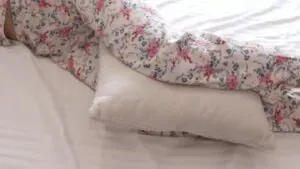
A pillow between the knees can help some side sleepers maintain a more comfortable hip and pelvic position.
Without support, the upper leg may fall forward and rotate the pelvis. A pillow between the knees can reduce that movement and make side sleeping feel more stable.
You can experiment with different pillow thicknesses. Too much separation may feel just as uncomfortable as too little, so use the smallest amount of support that improves comfort.
This is particularly useful if you notice that your back feels better when your legs are supported.
What if you prefer sleeping on your stomach?
Stomach sleeping is not automatically harmful, but it can be uncomfortable for some people with lower back pain.
The position can increase extension through the lower spine and requires your head to remain rotated to one side so you can breathe. Some people tolerate this without problems, while others notice increased back or neck discomfort.
If stomach sleeping consistently aggravates your symptoms, gradually experimenting with side or back sleeping may be worthwhile.
You do not have to change overnight. Start by spending part of the night on your side and use pillows to make the alternative position comfortable.
How should you change positions without hurting your back?
When your back is painful, turning in bed can sometimes feel more uncomfortable than remaining still.
Instead of twisting your upper body separately from your pelvis, try moving your shoulders and hips together. Bend your knees slightly and turn your body as a unit when rolling from your back to your side.
This can reduce sudden twisting and may make repositioning easier.
If you have severe pain after an injury, do not repeatedly test movements that significantly increase your symptoms. For example, persistent symptoms following back pain after a car accident may require medical evaluation rather than simply experimenting with sleeping positions.
Does your mattress affect the best sleeping position?
Yes. Your sleeping position and mattress work together.
A mattress that is too soft may allow the hips and pelvis to sink excessively, while an overly firm surface can create pressure around the shoulders and hips. The ideal surface depends on body shape, sleeping position, comfort, and the characteristics of the mattress.
Research comparing mattress firmness has generally favored medium-firm surfaces over very firm mattresses for some people with chronic nonspecific low back pain. That does not mean every person needs a medium-firm mattress.
If your mattress is old, sagging, or consistently uncomfortable, see what to look for when choosing a mattress for back pain.
Mattress and position: why they matter together
| Sleeping position | Mattress issue to watch for | What you want |
|---|---|---|
| Back | Excessive sinking around the pelvis | Even support |
| Side | Excessive pressure at shoulder and hip | Enough cushioning with support |
| Stomach | Excessive sinking through the abdomen/pelvis | Stable, comfortable support |
| Any position | Visible sagging | Consistent surface support |
A mattress should support your preferred sleeping position rather than forcing you to sleep in a position you find uncomfortable.
Can nighttime back pain be caused by something other than your sleeping position?
Yes. Pain that appears or becomes worse at night is not necessarily caused by the way you sleep.
Existing musculoskeletal pain may simply become more noticeable after several hours of inactivity. Other possible causes can also produce back discomfort, so it is useful to understand what causes back pain before assuming that your sleeping position is responsible.
If pain repeatedly wakes you, becomes progressively worse, or does not change when you alter your position, the pattern deserves more attention.
You can also learn more about why back pain gets worse at night if nighttime symptoms are your main concern.
What if your lower back hurts more after sleeping?
Morning pain does not automatically mean you slept in the wrong position.
Pain may be influenced by prolonged inactivity, an existing injury or condition, muscle stiffness, your mattress, or how much activity you did the previous day. The most useful clue is often what happens after you get up.
If gentle movement gradually reduces the discomfort, that pattern may be different from pain that steadily worsens regardless of activity.
Understanding common causes of lower back pain can help you consider the broader picture rather than focusing only on your sleep position.
Should you use heat or ice before bed?
Heat or cold may provide temporary symptom relief for some people, but neither is required simply because you have nighttime back pain.
Some people prefer warmth because it helps them relax before bed. Others find cold more comfortable during a flare-up.
If you are unsure whether to use heat or ice for back pain, choose the approach that is appropriate for your symptoms and does not irritate your skin.
Do not use excessive heat for long periods while sleeping. If you notice that heat makes back pain worse, stop using it.
Does exercise help you sleep with lower back pain?
Appropriate physical activity can be an important part of managing lower back pain, although the best exercise depends on the individual and the underlying problem.
Research on exercise for chronic low back pain supports it as a useful treatment component, but there is no single exercise program that works equally well for everyone. Exercise should also not be used as a reason to ignore symptoms that are rapidly worsening or associated with neurological problems.
For general movement ideas, see exercises that may ease lower back pain.
Avoid doing strenuous exercises immediately before bed if they consistently make you more uncomfortable. Gentle movement may be preferable when your goal is simply to settle into sleep.
What should you do if changing position does not help?
If changing positions, adjusting pillows, and improving your sleep setup do not make a meaningful difference, stop assuming that your sleeping position is the entire problem.
Persistent pain may require evaluation of other contributing factors. A broader explanation of back pain symptoms and different types of back pain can help you understand why location, duration, and associated symptoms matter.
You can also consider practical daytime measures rather than focusing exclusively on the hours you spend in bed. For uncomplicated symptoms, ways to relieve back pain at home may complement changes to your sleep routine.
Are certain symptoms a sign that you should not simply change your sleeping position?
Yes. Some symptoms require more than a change in pillows or sleeping posture.
For example, lower back pain accompanied by new bowel or bladder problems, significant weakness, saddle-area numbness, or severe neurological symptoms can require urgent assessment.
Digestive symptoms can also complicate the picture. If constipation occurs with back discomfort, the connection between constipation and back pain may be relevant.
Likewise, back pain associated with a noticeable abdominal or groin bulge may warrant considering whether a hernia can cause back pain.
These possibilities do not mean that your symptoms are caused by one of these conditions. They simply illustrate why persistent or unusual symptoms should not automatically be attributed to sleep posture.
What about pain around the ribs or upper back?
Sleeping position can affect more than the lower back. If discomfort is actually located higher in the back, around the ribs, or between the shoulder blades, the best approach may be different.
Information about pain around the ribs and back can help distinguish rib-area symptoms from typical lower back discomfort.
Pain associated with breathing also deserves attention. Back pain with breathing can have different possible causes, so significant or unexplained pain when taking a deep breath should not simply be blamed on how you slept.
What is the best bedtime routine for lower back pain?
A consistent routine can make it easier to determine whether your sleep setup is actually helping.
About an hour before bed, avoid activities that you know reliably aggravate your back. Use gentle movement if it normally helps, arrange your pillows before lying down, and choose a comfortable sleeping position rather than forcing your body into one prescribed posture.
When you get into bed, spend a few minutes finding a position that feels supported. If discomfort develops during the night, make small adjustments rather than repeatedly making large twists or stretches.
During the day, continue appropriate activity rather than spending most of the day in bed. For a broader approach to recovery, see ways to treat back pain.
A simple position checklist
Before going to sleep, ask yourself:
- Does my neck feel comfortably supported?
- Are my shoulders relaxed?
- Is my pelvis comfortable rather than twisted?
- If I am on my side, is a pillow between my knees helpful?
- If I am on my back, does supporting my knees reduce discomfort?
- Does my mattress feel supportive rather than excessively soft or hard?
- Can I change positions without significant pain?
You do not need to achieve perfect alignment. The purpose of these adjustments is to improve comfort and sleep, not to keep your spine in one rigid position all night.
Warning signs: when lower back pain needs medical attention
Symptoms that can often be monitored
Mild back stiffness that improves after getting up, changing position, or moving gently can often be monitored when there are no other concerning symptoms.
Symptoms that deserve medical evaluation
Arrange an evaluation if your pain persists, progressively worsens, repeatedly disrupts sleep, follows a significant injury, or is accompanied by symptoms that do not fit a straightforward musculoskeletal pattern.
Symptoms requiring urgent or emergency care
Seek urgent medical attention for new loss of bladder or bowel control, numbness around the groin or saddle area, significant or progressive weakness, severe neurological symptoms, or severe pain following major trauma.
For more detail, see when back pain is an emergency.
What does research say about sleeping positions and low back pain?
The research is more limited than many online recommendations suggest.
A 2025 systematic review identified only six observational studies specifically examining sleep posture and low back pain. The review found associations favoring back sleeping and supportive side sleeping, while stomach sleeping was associated with greater lumbar strain. Because these were observational studies and the evidence base was small, the findings should be treated as guidance rather than proof that one sleeping position prevents or cures back pain.
The broader burden of low back pain is substantial: global estimates indicate that approximately 619 million people experienced low back pain in 2020, with the number projected to reach 843 million by 2050. Most cases are classified as nonspecific, meaning a specific structural or disease-related cause cannot be identified.
Sleep itself is also relevant. A 2024 systematic review found that sleep problems are common among people with low back pain and that sleep characteristics may be associated with later pain, disability, and recovery. This supports a practical approach: improve sleep comfort while also addressing the broader factors affecting your back.
Frequently Asked Questions
1. What is the best sleeping position for lower back pain?
Back or side sleeping is a reasonable starting point for many people. The most useful position is the one that keeps you comfortable without significantly increasing your symptoms.
2. Is it better to sleep on your back or side with lower back pain?
Neither position is universally better. Back sleeping may support a relatively neutral position, while side sleeping can be comfortable when the pelvis and spine are well supported.
3. Where should I put a pillow if I sleep on my back?
Try placing a pillow underneath your knees. This may reduce pressure or extension through the lower back and can make the position more comfortable.
4. Where should I put a pillow if I sleep on my side?
Place a pillow between your knees so the upper leg does not fall forward and rotate your pelvis excessively. Adjust the pillow thickness until your hips feel comfortable.
5. Is stomach sleeping bad for lower back pain?
Stomach sleeping can increase lumbar extension for some people and may also require prolonged neck rotation. If it consistently increases your symptoms, experimenting with side or back sleeping may be worthwhile.
6. Should I sleep with my legs straight or bent?
There is no universal rule. If you sleep on your back, slightly supporting your knees may improve comfort; if you sleep on your side, a modest knee bend with a pillow between the legs may help.
7. Can my mattress affect my sleeping position?
Yes. A mattress that allows excessive sinking or creates pressure can make an otherwise comfortable sleeping position feel worse. Mattress firmness and support should therefore be considered together with your preferred position.
8. Why does my lower back hurt more when I wake up?
Morning pain can result from prolonged inactivity, your sleeping position, mattress support, or an existing back problem. If the pain improves with gentle movement, that pattern may provide useful information, but persistent symptoms should still be assessed when appropriate.
9. Should I stay in one position all night to protect my back?
No. You do not need to keep your spine completely still while sleeping. Changing positions naturally is normal, and you can move when a position becomes uncomfortable.
10. When should nighttime lower back pain worry me?
Nighttime pain is more concerning when it is severe, progressively worsening, repeatedly wakes you, follows major trauma, or occurs with neurological or other significant symptoms. New bladder or bowel dysfunction, saddle-area numbness, or significant weakness requires urgent attention.
Conclusion
The best sleeping position for lower back pain is usually the one that allows you to sleep comfortably without repeatedly aggravating your symptoms. Back sleeping with support under the knees and side sleeping with a pillow between the knees are practical options to try, while stomach sleeping may be less comfortable for some people.
Do not worry about maintaining perfect alignment all night. Focus on comfortable support, a mattress that works with your position, gentle movement during the day, and gradual adjustments based on how your symptoms respond.
If pain persists, worsens, repeatedly interrupts sleep, or occurs with neurological or other warning signs, changing your sleeping position is not enough. Those symptoms deserve appropriate medical evaluation.
Disclaimer: This article is provided for educational and informational purposes only. It is not a substitute for professional medical advice, diagnosis, or treatment