Chest pain can be alarming, especially when it occurs at the same time as pain in the upper or middle back. You may feel discomfort between the shoulder blades, around the ribs, or across the front of the chest. Because several conditions can produce similar symptoms, it is not always obvious whether the pain is coming from the back, chest wall, heart, lungs, or another source.
Yes, chest pain can sometimes come from a back problem. Muscles, joints, ribs, and nerves in the thoracic spine are closely connected with the chest wall. Irritation or injury in these structures can produce pain that travels from the back around the ribs and toward the front of the chest.
However, chest pain should never automatically be blamed on the back. Heart and lung conditions, digestive problems, and other medical issues can also cause chest and back pain together. New, unexplained, severe, or persistent chest pain deserves appropriate medical attention.
Can a Back Problem Cause Chest Pain?
Yes. Problems involving the upper or middle back can sometimes cause pain that is felt in the chest.
The thoracic spine forms the central framework of the upper and middle back. Ribs attach to this region and curve around the chest, while nerves travel from the spinal cord toward the chest wall. Muscles and connective tissues also connect the spine, ribs, shoulders, and chest.
Because these structures work together, irritation in one area may be perceived somewhere else. This is often described as referred pain.
Common back-related causes of chest-area pain include:
-
Muscle strain: An overstretched or irritated upper-back or chest-wall muscle can cause aching or sharp pain.
-
Rib or spinal joint irritation: The joints connecting the ribs with the thoracic spine can become painful after repetitive movement, strain, or injury.
-
Thoracic spine problems: Conditions affecting the middle portion of the spine can sometimes produce pain around the torso.
-
Nerve irritation: A thoracic nerve can cause burning, shooting, tingling, or band-like pain extending from the back toward the chest.
-
Chest-wall strain: Muscles between and around the ribs may become irritated after coughing, exercise, lifting, or sudden movements.
For a broader overview of common causes and patterns of back discomfort, see what causes back pain.
Can Upper Back Muscle Strain Cause Chest Pain?
Yes. An irritated muscle in the upper or middle back can sometimes produce pain that extends toward the ribs or chest.
Muscle-related pain may develop after:
-
Lifting something heavy
-
Repetitive reaching
-
Exercise or sports
-
Twisting suddenly
-
Prolonged work in one position
-
An awkward sleeping or working position
-
A sudden increase in physical activity
Musculoskeletal pain often changes with movement. You may notice more discomfort when twisting your torso, moving your shoulder, reaching overhead, bending, or stretching.
The area may also feel tender when touched.
These features can make a musculoskeletal source more likely, but they do not prove that chest pain is coming from a muscle. Serious conditions can sometimes produce unusual or overlapping symptoms.
Can a Pinched Nerve in the Back Cause Chest Pain?
An irritated thoracic nerve can cause pain that travels from the back around the chest.
Thoracic spinal nerves pass from the spine toward the chest wall between the ribs. When a nerve is irritated, pain may follow the nerve’s pathway rather than remaining in one small area.
Nerve-related pain may feel:
-
Burning
-
Electric or shooting
-
Sharp
-
Tingling
-
Numb
-
Hypersensitive to touch
-
Like a narrow band wrapping around the chest
This type of pain can be confusing because it may feel as though the problem is inside the chest rather than in the back.
Persistent chest-area pain, particularly when accompanied by significant numbness, weakness, or other neurological symptoms, should be evaluated by a healthcare professional.
Can a Rib Problem Cause Chest Pain From the Back?
Yes. A problem involving the ribs can produce pain in both the back and chest.
Each rib connects toward the thoracic spine and curves around the body toward the front of the chest. An irritated or injured rib, rib joint, or surrounding muscle can therefore create discomfort along this pathway.
Rib-related pain may become more noticeable when you:
-
Take a deep breath
-
Cough or sneeze
-
Laugh
-
Twist your torso
-
Lie on the affected side
-
Move your upper body
-
Press over the painful area
A recent fall, blow to the chest, intense exercise, or sudden movement can provide an important clue.
If your symptoms specifically involve the ribs and surrounding back area, back rib pain provides more focused information.
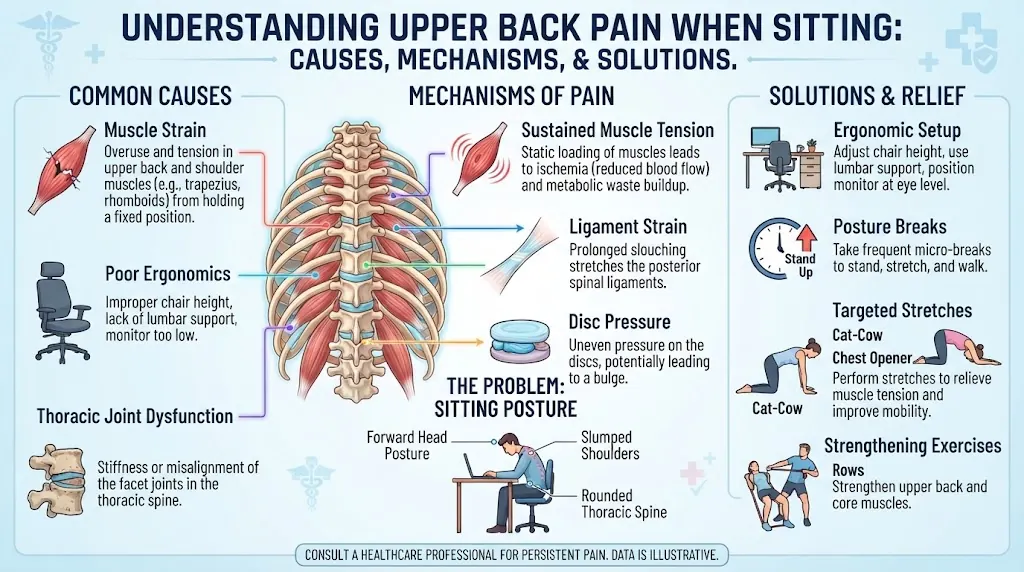
Can Poor Posture Cause Chest and Back Pain?
Poor posture and prolonged static positions can contribute to upper-back and chest-wall discomfort.
For example, sitting at a desk for hours with limited movement can place sustained demands on the muscles around the shoulder blades, thoracic spine, and chest. This may contribute to stiffness, muscular fatigue, and discomfort.
Rather than trying to hold one rigid posture all day, it is generally more useful to change positions regularly.
Helpful habits include:
-
Take movement breaks: Stand, walk, or gently move your shoulders after prolonged sitting.
-
Adjust your workstation: Keep your screen and chair positioned so you do not constantly lean forward.
-
Build strength gradually: Appropriate upper-back, shoulder, and core strengthening can support comfortable movement.
-
Avoid prolonged static positions: Even a comfortable position can become uncomfortable when maintained for too long.
If your discomfort is concentrated in the lower part of the back rather than the chest and upper back, see the guide to lower back pain.
Can Back Problems Cause Chest Tightness?
Back and chest-wall muscle tension can sometimes contribute to a feeling of tightness or pressure.
However, chest tightness can also occur with potentially serious heart and lung conditions. It should not automatically be interpreted as muscle tension.
Seek urgent medical evaluation if chest tightness is new, severe, occurs during physical exertion, or is accompanied by symptoms such as:
-
Shortness of breath
-
Cold sweating
-
Nausea
-
Fainting or severe dizziness
-
Weakness
-
Pain spreading to the arm, jaw, neck, shoulder, or back
The sensation alone is not enough to determine the cause.
How Can You Tell If Chest Pain May Be Coming From Your Back?
There is no reliable way to diagnose the cause of chest pain at home. A healthcare professional may need to consider your symptoms, medical history, physical examination, and, when appropriate, further testing.
Certain features can nevertheless provide useful clues.
Pain Changes With Movement
If turning, bending, reaching, or moving your shoulder consistently changes the pain, a musculoskeletal source may be more likely.
The Area Is Tender
Pain that can be reproduced by pressing on a specific muscle, rib, or chest-wall area can occur with musculoskeletal conditions.
There Was a Physical Trigger
Symptoms that began after lifting, exercise, repetitive work, coughing, a sudden movement, or an injury may point toward a muscle, rib, or joint problem.
The Pain Travels Around the Torso
Pain that starts near the thoracic spine and follows a band-like path around the ribs may occur with irritation of a thoracic nerve.
There Are No Emergency Symptoms
The absence of significant breathing difficulty, fainting, severe dizziness, or other warning signs is reassuring, but it does not completely exclude a serious cause.
Pain around the ribs and back can have several possible explanations, so symptoms should be considered as a complete pattern rather than judged by location alone. More information is available in the guide to pain around the ribs and back.
When Chest Pain May Not Be Coming From the Back
Sometimes the back and chest hurt because both areas are being affected by the same underlying condition.
Heart-Related Causes
Some heart conditions can cause discomfort in the chest that spreads toward the back, shoulders, arms, neck, or jaw.
The sensation may be described as pressure, squeezing, heaviness, tightness, or discomfort rather than a simple sharp pain.
Heart-related symptoms do not always follow one predictable pattern. That is why new or unexplained chest pain should not be dismissed simply because it feels different from what you expected.
Lung-Related Causes
Conditions affecting the lungs or pleura can produce chest pain that is also felt toward the back.
Pain that worsens with breathing or coughing can occur with several chest and lung conditions. Fever, cough, sudden symptoms, or difficulty breathing can provide additional clues.
If your back pain is specifically associated with breathing, see back pain when breathing for a more focused discussion.
Digestive Causes
Acid reflux and other digestive conditions can cause discomfort in the chest or upper abdomen and may sometimes be felt toward the back.
Even so, chest pain should not automatically be labelled as reflux simply because it appears after eating. Other causes may need to be considered.
Can Chest Pain Come From a Back Problem on the Left Side?
Yes. A muscle, rib, joint, or nerve problem can cause pain on the left side of the chest and back.
But left-sided chest pain should never automatically be assumed to be muscular.
Heart-related pain can also occur on the left side or spread toward the back. If the pain is new or unexplained, particularly when it occurs with shortness of breath, sweating, nausea, dizziness, weakness, or pain extending into the arm, jaw, neck, or back, seek urgent medical evaluation.
For people experiencing pain specifically in the lower left portion of the back, the possible causes can differ. See lower-left-sided back pain in women for information focused on that symptom pattern.
Can Chest Pain Come From a Back Problem on the Right Side?
Yes. Muscles, ribs, spinal joints, and nerves can all cause right-sided chest or upper-back pain.
Right-sided pain is not automatically harmless, however. Lung, digestive, gallbladder, and other conditions can also produce pain in this region.
The side of the body is only one part of the clinical picture. The timing, severity, triggers, associated symptoms, and progression of the pain are also important.
For symptoms concentrated in the lower right portion of the back, see lower back pain on the right side.
What Does Chest Pain From a Back Problem Feel Like?
There is no single sensation that proves chest pain is coming from the back.
Depending on the structure involved, the discomfort may feel:
-
Aching or sore
-
Sharp
-
Burning
-
Tight
-
Stiff
-
Shooting
-
Band-like around the ribs
-
Worse with certain movements
Muscle and joint pain often responds to movement or pressure. Nerve irritation may feel more burning, electric, tingling, or band-like.
The important point is that the quality of pain alone cannot reliably identify its cause.
Chest Pain That Gets Worse With Movement
Chest pain that clearly changes when you twist, bend, reach, or move your shoulder can occur with musculoskeletal problems.
For example, a strained muscle or irritated rib joint may hurt when the surrounding structures are loaded or stretched.
However, movement-related pain does not completely rule out heart, lung, or other medical causes.
If the pain is new, severe, persistent, or accompanied by concerning symptoms, seek medical assessment rather than relying on movement as a self-diagnostic test.
Chest Pain That Gets Worse When Breathing
Pain during deep breathing can occur when the ribs, intercostal muscles, or chest wall are irritated.
A bruised rib or strained chest-wall muscle, for example, may become painful as the rib cage expands.
But pain with breathing can also occur with conditions affecting the lungs or pleura.
It is important to distinguish pain when breathing from difficulty breathing. Actual shortness of breath is more concerning and warrants appropriate medical assessment.
How Is Chest and Back Pain Diagnosed?
A healthcare professional will usually begin by taking a detailed history and performing a physical examination.
They may ask:
-
When did the pain begin?
-
Did it start suddenly or gradually?
-
Where exactly do you feel it?
-
Does it move between the back and chest?
-
Does movement change the symptoms?
-
Does deep breathing or coughing affect the pain?
-
Did you recently exercise, lift, or perform repetitive activity?
-
Was there an injury?
-
Do you have shortness of breath?
-
Do you have a cough or fever?
-
Have you experienced dizziness or fainting?
-
Does the pain occur during physical activity?
-
Do you have other symptoms that began around the same time?
The examination may include the chest wall, ribs, thoracic spine, heart, lungs, and neurological system.
Depending on the presentation, a clinician may recommend additional testing. The appropriate tests depend on the suspected cause and the individual’s symptoms.
Treatment When a Back Problem Is the Cause
Treatment depends on the structure involved and the underlying diagnosis.
Mild Musculoskeletal Pain
When a healthcare professional determines that the symptoms are musculoskeletal and there are no warning signs, management may include:
-
Modify aggravating activities: Temporarily reduce heavy lifting or movements that clearly increase the pain.
-
Stay gently active: Comfortable movement is generally preferable to prolonged bed rest.
-
Use heat or cold: A protected heat or cold pack may provide temporary symptom relief.
-
Improve movement habits: Break up long periods of sitting or repetitive activity.
-
Consider physical therapy: Persistent or recurrent symptoms may benefit from individualized mobility, strengthening, and movement training.
If the discomfort is part of a broader back-pain pattern, the information in this back pain guide may help explain how different causes are evaluated and managed.
Rib Injuries
Rib injuries may take time to settle because the chest wall moves continuously during breathing.
Follow professional guidance regarding pain control and activity. Avoid tightly binding or wrapping the chest unless specifically instructed by a healthcare professional.
Nerve or Spine Problems
When a thoracic nerve or spinal condition is responsible, treatment may include physical therapy, medication, activity modification, or treatment directed at the underlying spinal problem.
The correct approach depends on the diagnosis rather than simply the location of the pain.
How Long Can Back-Related Chest Pain Last?
There is no single recovery timeline for chest pain caused by a back problem.
A minor muscle strain may gradually improve with appropriate activity modification, while a rib injury may take longer. Persistent nerve or spinal problems may require targeted treatment.
Instead of focusing only on a specific number of days, pay attention to the overall trend.
Gradually decreasing pain, improving movement, and better tolerance of normal activities are generally more reassuring than symptoms that continue to worsen, repeatedly return, or develop without an obvious explanation.
Persistent unexplained chest pain should be evaluated rather than managed indefinitely at home.
When Should You See a Doctor for Chest and Back Pain?
Arrange a medical evaluation when:
-
The chest pain is new and unexplained. Do not automatically attribute it to a back problem.
-
The symptoms persist. Pain that does not improve deserves assessment.
-
The pain repeatedly returns. Recurrent chest and back pain may require investigation.
-
It occurs during exertion. Chest discomfort associated with physical activity should be evaluated.
-
Other symptoms develop. Fever, cough, breathing difficulty, dizziness, nausea, weakness, or neurological changes can indicate another cause.
-
The pain is becoming more severe. Worsening symptoms should not be ignored.
Emergency Warning Signs
Seek Emergency Medical Attention If You Have:
-
Sudden or severe chest pain
-
Chest pressure, squeezing, or heaviness
-
Significant difficulty breathing
-
Pain spreading to the arm, jaw, neck, shoulder, or back
-
Fainting or severe dizziness
-
Cold sweating with chest pain
-
Severe nausea or vomiting with chest discomfort
-
Coughing up blood
-
Sudden severe chest and upper-back pain
-
A very rapid or irregular heartbeat accompanied by severe symptoms
Do not wait to see whether stretching, massage, rest, or changing position makes the symptoms disappear when emergency warning signs are present.
If you are unsure whether symptoms represent an emergency, it is safer to seek urgent medical assessment rather than trying to determine the cause yourself.
Frequently Asked Questions
Can chest pain really come from a back problem?
Yes. Muscle strains, rib and spinal joint irritation, thoracic spine problems, and irritated nerves can sometimes cause pain that is felt in the chest.
Can a pinched nerve in the back cause chest pain?
An irritated thoracic nerve can produce burning, shooting, tingling, numbness, or band-like pain around the ribs and chest. Because the nerve travels from the spine toward the chest wall, the symptoms may feel as though they originate in the chest.
Can upper-back muscle pain cause chest pain?
Yes. An irritated upper-back or chest-wall muscle can produce pain that spreads toward the ribs or chest, particularly when movement or pressure reproduces the discomfort.
Can poor posture cause chest pain?
Prolonged static positions and poor movement habits can contribute to upper-back and chest-wall discomfort. Regular movement breaks and appropriate strengthening may help when the symptoms are musculoskeletal.
Can a rib problem cause chest pain from the back?
Yes. Rib injuries and irritation of the joints connecting the ribs to the thoracic spine can cause pain that extends around the side of the body and into the chest.
How can I tell if chest pain is muscular?
Pain that changes with movement or pressure and began after exercise, lifting, repetitive activity, or an injury may be more consistent with a musculoskeletal source. However, these features cannot completely rule out serious causes of chest pain.
Can back pain cause chest tightness?
Muscle and chest-wall tension can contribute to tightness, but chest tightness can also occur with heart and lung conditions. New, severe, or unexplained tightness should be medically evaluated.
Can chest pain from a back problem occur on the left side?
Yes. Musculoskeletal problems can cause left-sided chest pain, but heart-related conditions can also produce left-sided or chest-to-back discomfort. New or concerning left-sided chest pain should not automatically be attributed to the back.
Can chest pain from a back problem get worse when breathing?
Yes. Rib and chest-wall problems can become painful when the rib cage expands during deep breathing. Lung and pleural conditions can also cause pain with breathing, so the overall symptom pattern matters.
When is chest and back pain an emergency?
Sudden severe chest pain, significant difficulty breathing, fainting, coughing blood, cold sweating, severe dizziness, or pain spreading to the arm, jaw, neck, shoulder, or back requires urgent medical attention.
Key Takeaway
Chest pain can come from a back problem, particularly when muscles, ribs, thoracic joints, or nerves are irritated. Musculoskeletal pain may change with movement, pressure, or certain positions and can sometimes travel from the upper or middle back around the ribs toward the chest.
But chest pain has many possible causes, and symptoms can overlap. Heart, lung, digestive, and other conditions can produce chest and back discomfort as well.
For that reason, do not use the location or movement of the pain alone to diagnose yourself. New, unexplained, severe, persistent, or worsening chest pain should receive appropriate medical evaluation.
If emergency warning signs such as severe chest pressure, significant breathing difficulty, fainting, coughing blood, cold sweating, or pain spreading to the arm, jaw, neck, or back occur, seek emergency medical attention.
Disclaimer: This article is intended for educational purposes only and should not be considered personalized medical advice.