The discomfort may begin after walking a short distance and ease when you sit down or lean forward. Although this pattern is common with lumbar spinal stenosis, other conditions can also cause walking-related leg pain, so symptoms alone cannot confirm the cause.
Understanding why spinal stenosis affects walking can help you recognize common symptoms, adjust activities safely, and know when to seek medical evaluation. The right approach depends on symptom severity, nerve function, and your overall health.
How Does Spinal Stenosis Cause Leg Pain When Walking?
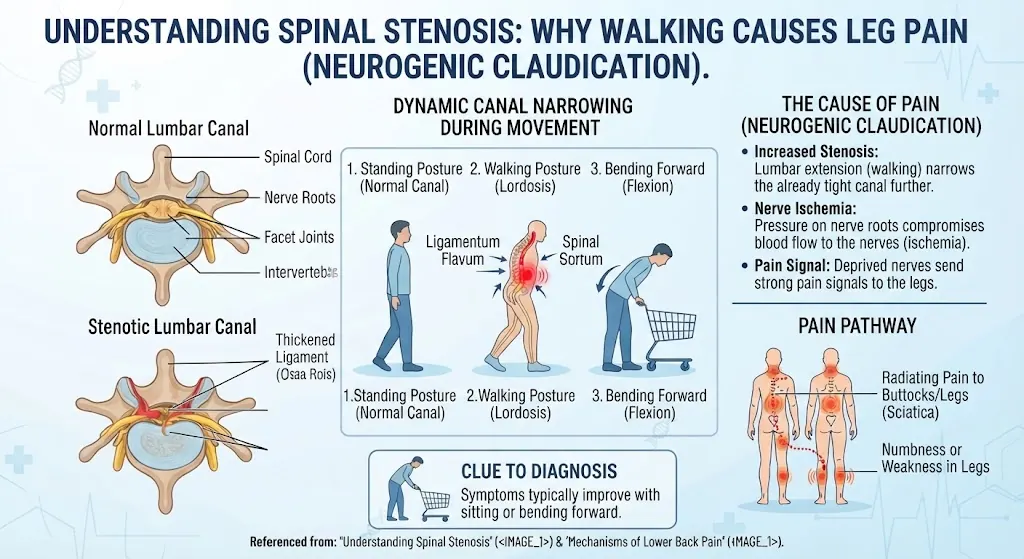
Lumbar spinal stenosis occurs when the space inside the lower spinal canal or around the nerve openings becomes narrower. Age-related changes, such as thickened ligaments, arthritis, and bulging discs, can contribute to this narrowing.
When you stand or walk, the position of your lower spine may further reduce available space around already crowded nerves. This can interfere with nerve function and produce symptoms in the buttocks, thighs, calves, or feet. The walking-related pattern is often called neurogenic claudication.
For a broader overview, see what spinal stenosis feels like.
What Does Spinal Stenosis Leg Pain Feel Like?
Symptoms vary from person to person. Some people experience pain, while others mainly notice weakness, numbness, or heaviness.
| Symptom | What you may notice |
|---|---|
| Leg aching or pain | Discomfort in the buttocks or legs after standing or walking |
| Numbness or tingling | Reduced sensation or pins and needles in the legs or feet |
| Heavy legs | A feeling that your legs are difficult to move normally |
| Leg weakness | Reduced strength, balance, or confidence while walking |
| Relief when sitting | Symptoms improve when sitting or bending forward |
Some people develop symptoms in both legs, although one side may be more affected. Others experience lower back discomfort alongside leg symptoms, while some have little or no back pain.
The relationship between back pain and heavy legs can be useful to understand when discussing your symptoms with a clinician.
Why Does Walking Make Spinal Stenosis Pain Worse?
Walking keeps your spine upright and repeatedly loads the lower back. In some people with lumbar stenosis, standing and extending the spine reduces space around the nerves, bringing on symptoms.
Sitting or leaning forward often bends the lower spine slightly forward, which may increase available space around the affected nerves. This explains why some people can walk farther while leaning on a shopping cart than while walking upright.
However, not all walking-related leg pain comes from spinal stenosis. For example, reduced blood flow to the legs can cause pain during activity that improves with rest. A clinician can help distinguish these possibilities. Learn more about why spinal stenosis causes leg pain when walking.
What Can Make the Symptoms Worse?
Several factors may aggravate symptoms, although triggers differ between individuals:
-
Standing in one position for a long time.
-
Walking farther than your current tolerance allows.
-
Walking downhill or keeping your back extended.
-
Repeatedly arching or twisting the lower back.
-
Increasing activity too quickly after a period of reduced movement.
Spinal stenosis may develop gradually, but symptom severity does not always match the degree of narrowing seen on imaging. Some people have spinal narrowing without significant symptoms.
What Can Help Relieve Leg Pain From Spinal Stenosis?
Treatment aims to improve mobility, manage symptoms, and preserve nerve function. The most appropriate option depends on your examination and how much daily activities are affected.
| Approach | Potential benefit | Important consideration |
|---|---|---|
| Activity adjustments | May reduce symptoms triggered by prolonged standing | Avoid pushing through increasing weakness or numbness |
| Physical therapy | Can improve strength, balance, flexibility, and walking tolerance | Exercises should be adapted to your symptoms |
| Pain medication | May help some people manage discomfort | Benefits and risks depend on the medicine and your health |
| Specialist evaluation | Helps clarify the cause and discuss treatment choices | Imaging findings must be interpreted alongside symptoms |
A clinician or physical therapist may recommend exercises that emphasize comfortable positions, trunk and hip strength, and gradual conditioning. Do not assume that every back stretch is appropriate; movements that increase leg symptoms should be modified or stopped.
Explore what helps spinal stenosis pain and physical therapy for lower back pain. General exercises for lower back pain may need adjustment for spinal stenosis.
Shorter walks with rest breaks may be more manageable than one long walk. You can also discuss whether to rest or keep moving with lower back pain and safe ways to relieve back pain at home.
How Is Spinal Stenosis Diagnosed?
Evaluation typically includes questions about when symptoms begin, how far you can walk, what relieves the pain, and whether you have numbness or weakness. A physical examination may assess leg strength, sensation, reflexes, balance, and walking.
An MRI may be considered when symptoms suggest nerve compression, when neurological problems are present, or when imaging would help guide treatment. A scan alone cannot establish that spinal stenosis is causing your symptoms. Read about when lower back pain needs an MRI and what an MRI can show about lower back pain.
Spinal stenosis can overlap with other conditions. Comparing spinal stenosis vs. sciatica or spinal stenosis vs. a herniated disc may help explain the differences, but a medical assessment is needed to identify the cause.
When Should You Seek Medical Care?
| Level of concern | Symptoms or situation | What to do |
|---|---|---|
| Monitor and arrange routine care | Stable symptoms that appear with walking and improve with sitting | Track walking tolerance and discuss persistent symptoms with a clinician |
| Prompt medical evaluation | Increasing pain, new numbness, worsening walking ability, or leg weakness | Arrange medical assessment promptly |
| Emergency care | New loss of bladder or bowel control, inability to urinate, numbness around the groin or saddle area, or rapidly worsening leg weakness | Seek emergency care immediately |
These warning signs can indicate serious nerve compression or another urgent condition. Do not wait for a routine appointment if they occur. See spinal stenosis emergency symptoms and when to see a doctor for lower back pain.
If symptoms gradually worsen or walking becomes increasingly difficult, reassessment is important. Learn about whether spinal stenosis can worsen over time.
Frequently Asked Questions
1. Can spinal stenosis cause leg pain without back pain?
Yes. Spinal stenosis can irritate or compress nerves that supply the legs even when lower back pain is minimal or absent.
2. Why does my leg pain improve when I sit down?
Sitting often bends the lower spine forward, potentially creating more room around compressed nerves. Relief with sitting is a common pattern in lumbar spinal stenosis but is not proof of the condition.
3. Can spinal stenosis affect both legs?
Yes. Lumbar spinal stenosis can cause symptoms in both legs, though one leg may be more affected. The pattern depends on which nerves are involved.
4. Does spinal stenosis always get worse?
No. Symptoms may remain stable, fluctuate, or worsen over time. Changes in walking ability, sensation, or strength warrant reassessment.
5. Is walking good for spinal stenosis?
Walking may help maintain fitness and mobility when symptoms allow. Shorter distances, breaks, and a comfortable forward-leaning position may help, but stop and seek advice if symptoms significantly worsen.
6. Can spinal stenosis cause numb feet?
Yes. Nerve compression can produce numbness or tingling in the feet, although circulation problems and other nerve conditions can cause similar symptoms.
7. Do exercises reverse spinal stenosis?
Exercises generally do not reverse structural narrowing. However, an individualized program may improve strength, function, and tolerance for daily activities.
8. Does spinal stenosis require surgery?
Not always. Treatment often begins with nonsurgical options, while surgery may be considered when symptoms remain disabling despite appropriate care or when significant neurological problems develop.
9. How is spinal stenosis different from poor circulation?
Spinal stenosis often causes symptoms related to posture, with relief from sitting or bending forward. Circulation-related pain may improve simply by stopping activity, so clinical evaluation may be needed to distinguish them.
10. When is leg pain from spinal stenosis an emergency?
New bladder or bowel dysfunction, numbness around the groin, or rapidly worsening leg weakness requires emergency assessment. Do not assume these symptoms are just part of ordinary spinal stenosis.
Conclusion
Spinal stenosis can cause leg pain during walking when narrowed spaces around the spinal nerves interfere with nerve function. Sitting or leaning forward may help, but persistent symptoms, declining walking ability, or new weakness deserve medical evaluation. Seek emergency care for serious neurological warning signs.
Disclaimer: This article is provided for educational and informational purposes only.