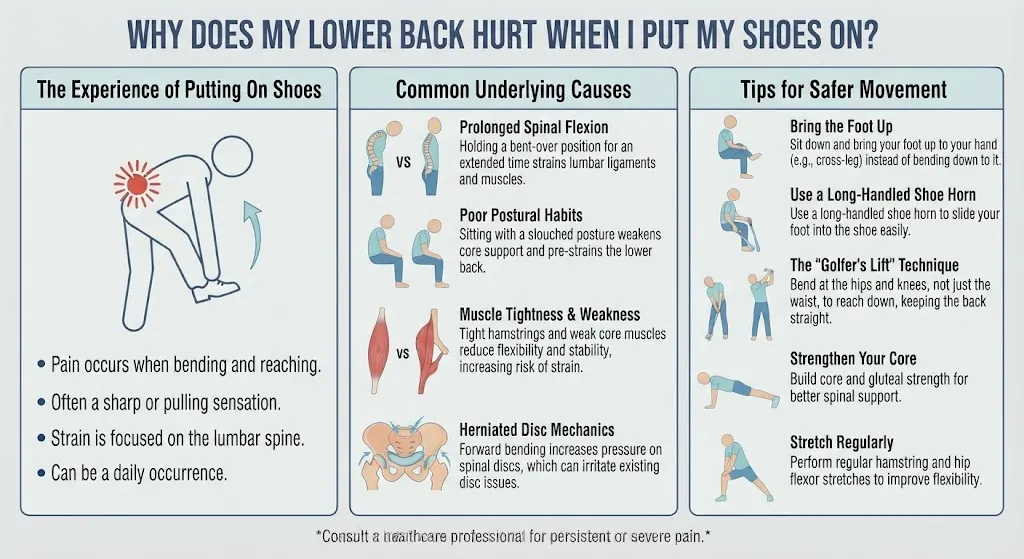
Putting on shoes can turn into an uncomfortable task when bending forward causes a sharp ache, pulling sensation, or stiffness in your lower back. You might notice the pain when reaching for your foot, lifting your leg, or tying your laces, even if walking and standing feel relatively comfortable.
Lower back pain when putting on shoes is often related to how bending, twisting, and balancing load the muscles, joints, and other structures around your spine. However, pain during this movement does not automatically mean you have a herniated disc or a serious back injury.
Understanding why this particular movement hurts can help you adjust your technique, manage discomfort safely, and recognize when professional evaluation is appropriate. The location, severity, duration, and accompanying symptoms all help determine what to do next.
Why Does Bending to Put on Shoes Cause Lower Back Pain?
Bending forward changes the position of your spine and hips while your back muscles help control the movement. If these tissues are irritated or sensitive, reaching toward your feet may reproduce pain.
Common explanations include:
- Muscle strain: Overstretched or irritated muscles may hurt when you bend, straighten up, or reach toward your feet.
- Joint irritation: Small joints in the spine can become painful during certain movements, particularly when the back is already sensitive.
- Disc-related irritation: Bending may aggravate symptoms associated with an intervertebral disc, sometimes causing pain that travels into the buttock or leg.
- Limited hip mobility: If your hips do not bend comfortably, you may compensate by rounding your lower back more than usual.
- Nerve irritation: Pain accompanied by tingling, numbness, or leg symptoms may indicate nerve involvement.
These possibilities overlap, so the movement that triggers pain cannot identify the exact cause by itself. For a broader overview, see what causes lower back pain and common lower back pain symptoms.
What Different Pain Patterns May Mean
| Symptom pattern | Possible explanation | What to notice |
|---|---|---|
| Local ache when bending | Muscle or joint irritation | Whether straightening up eases the pain |
| Sharp pain after lifting or twisting | Possible muscle strain or other mechanical irritation | Whether movement or lifting triggers symptoms |
| Pain traveling into the buttock or leg | Possible nerve irritation | Tingling, numbness, or weakness |
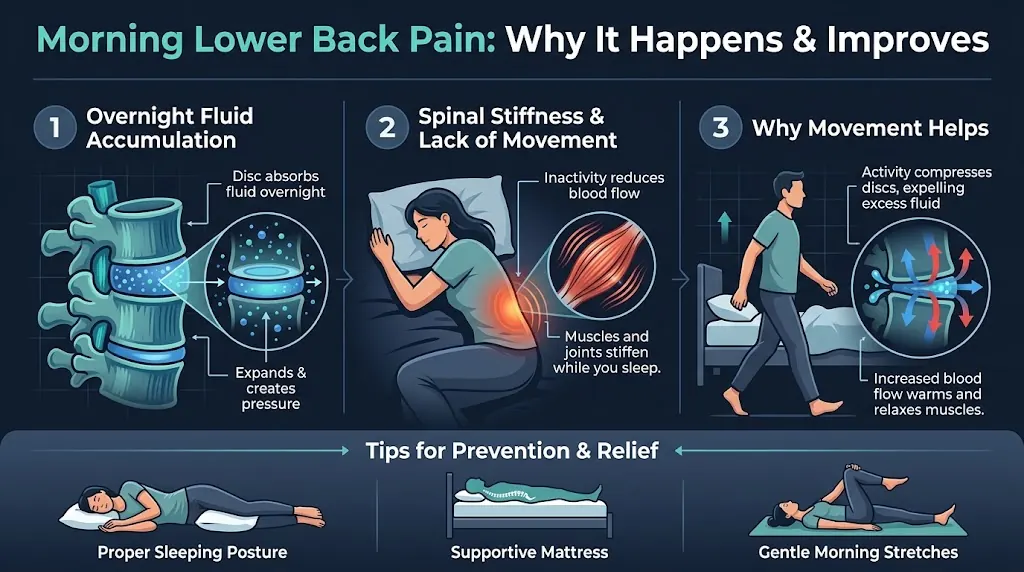
| Stiffness after sitting or sleeping | Movement-related stiffness or several other causes | How long stiffness lasts and whether it improves |
| Severe pain after a fall or injury | Possible significant injury | Pain intensity, mobility, and other symptoms |
This table is a guide to symptom patterns, not a diagnostic tool. Similar symptoms can occur with different conditions.
How Can You Put on Shoes Without Hurting Your Back?
Changing your technique can reduce the amount of bending and twisting required. Try these practical adjustments:
- Sit down first. Use a stable chair instead of balancing on one leg while bending.
- Bring your foot closer. Rest your foot on a low, stable support if that position feels comfortable.
- Use a long-handled shoehorn. This can reduce repeated reaching and bending.
- Move through your hips. Bend your hips and knees rather than forcing your lower back into a deep forward bend.
- Avoid twisting while bent over. Turn your whole body instead of rotating your trunk sharply.
- Choose easy-to-wear footwear temporarily. Slip-on shoes or adjustable closures may help while symptoms settle.
If standing up from a chair also hurts, the advice in why your lower back hurts when getting out of a chair may help you identify other movement triggers.
What Can You Do at Home to Relieve the Pain?
For mild discomfort without warning signs, gentle activity and temporary movement adjustments are often reasonable first steps.
| Approach | How to use it | Important consideration |
|---|---|---|
| Gentle movement | Take short walks and change positions regularly | Reduce activity that clearly worsens symptoms |
| Heat | Apply comfortable warmth for 15–20 minutes | Protect your skin and avoid excessive heat |
| Ice | Wrap a cold pack in a towel and apply briefly | Stop if the skin becomes painful or irritated |
| Modified bending | Use a chair and shoehorn | Do not force a painful range of motion |
| Gradual exercise | Resume comfortable movement as symptoms allow | Stop movements that increase radiating pain, numbness, or weakness |
For additional guidance, explore how to relieve back pain at home, whether heat or ice is better for back pain, and exercises for lower back pain.
Avoid aggressive stretching, repeated deep forward bends, and heavy lifting if they aggravate your symptoms. Prolonged bed rest is generally not recommended for uncomplicated back pain; gentle, tolerable activity is usually preferable.
When Should You See a Doctor?
The pattern and progression of symptoms matter more than the shoe-tying movement alone.
| Level of concern | Signs | Recommended action |
|---|---|---|
| Usually reasonable to monitor | Mild pain that improves and does not limit ordinary movement significantly | Modify painful movements and monitor progress |
| Arrange medical evaluation | Persistent, recurrent, worsening, or function-limiting pain; pain spreading down the leg; new tingling or numbness | Contact a healthcare professional |
| Seek emergency care | New loss of bladder or bowel control, difficulty starting urination with back symptoms, numbness around the groin or saddle area, or rapidly progressive leg weakness | Go to an emergency department immediately |
Severe pain after a significant fall or accident also warrants prompt assessment. Fever, unexplained weight loss, a history of cancer, or persistent pain that is unusual for you should be discussed with a clinician.
For more detail, see when to seek emergency care for back pain and when you should see a doctor for lower back pain.
Frequently Asked Questions
1. Why does my back hurt only when I bend to put on shoes?
Certain positions place different demands on your muscles, joints, and discs. Pain occurring only during bending may reflect movement sensitivity, but it does not establish a specific diagnosis.
2. Could putting on shoes cause a herniated disc?
Ordinary shoe-tying is unlikely to injure a healthy back by itself, although bending or twisting may aggravate an existing problem. Learn what a herniated disc can feel like.
3. Why does the pain shoot into my leg when I bend?
Pain traveling from the back into the buttock or leg can occur with nerve irritation, including sciatica. New weakness, substantial numbness, or rapidly worsening symptoms require prompt assessment.
4. Should I stop bending forward completely?
Not necessarily. Temporarily limit painful bending and use alternative techniques, then gradually resume comfortable movement as symptoms improve.
5. Is it better to sit or stand while putting on shoes?
Sitting on a stable chair usually reduces the balance demands of standing on one leg. You can also use a shoehorn to limit how far you need to reach.
6. Can tight hamstrings make my lower back hurt?
Limited flexibility in the hips or legs may change how you bend, potentially increasing the demands on your back. However, tightness alone does not prove it is the cause of your pain.
7. Should I stretch my lower back when it hurts?
Gentle movement may help, but forceful stretching can aggravate sensitive tissues. Stop any stretch that causes sharp pain or increases symptoms down your leg.
8. How long should this type of back pain last?
Mild mechanical back pain may improve over several days or weeks, depending on the cause. Seek evaluation if it worsens, repeatedly returns, or fails to improve as expected.
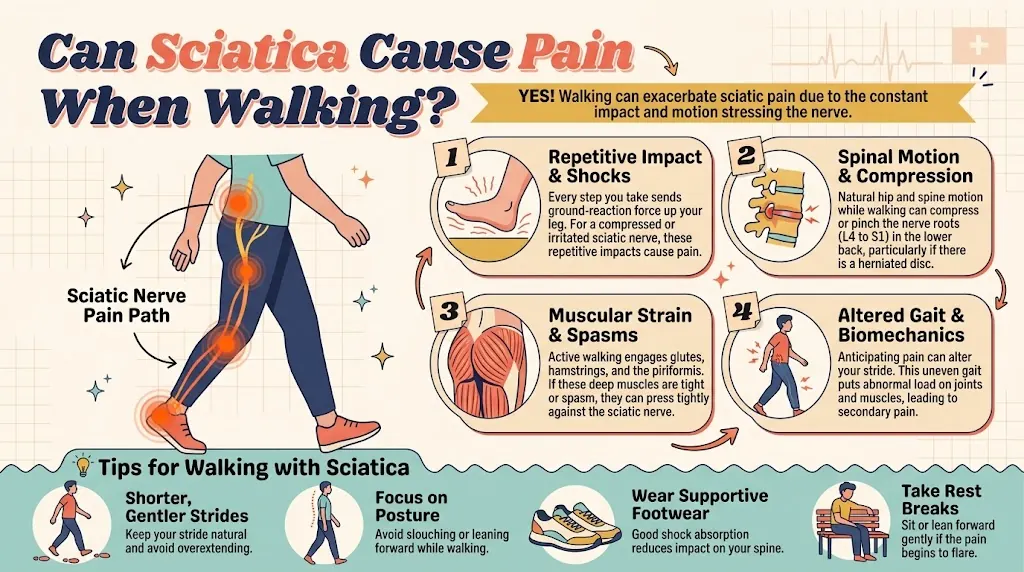
9. Can sciatica make putting on shoes difficult?
Yes. Bending may aggravate symptoms in some people with sciatica, especially when pain travels into the buttock or leg. The causes and symptoms of sciatica can help explain this pattern.
10. Do I need an MRI for lower back pain when bending?
An MRI is not routinely necessary for uncomplicated lower back pain. A clinician determines whether imaging is appropriate based on your symptoms, examination, medical history, and any warning signs; see when a lower back MRI may be needed.
The Bottom Line
Lower back pain when putting on shoes often reflects sensitivity to bending, muscle or joint irritation, or another movement-related problem. Sitting down, bringing your foot closer, using a shoehorn, and staying gently active may make the task easier. If pain persists, worsens, spreads into your leg, or comes with warning signs, seek appropriate medical care.
Disclaimer: This article is provided for educational and informational purposes only.