The cause is not always a back muscle injury. Pain during leg lifting can come from strained muscles, irritated spinal joints, a sensitive nerve, or a problem involving a spinal disc or hip. The movement that triggers the pain, its location, and whether you experience tingling, numbness, or weakness can help a healthcare professional determine what needs further evaluation.
Understanding why your lower back hurts when you lift your leg can help you choose safer movements and recognize when medical attention is necessary. This guide explains common causes, how straight-leg lifting differs from bending your knee, what you can do at home, and which warning signs should not be ignored.
What Causes Lower Back Pain When Lifting Your Leg?
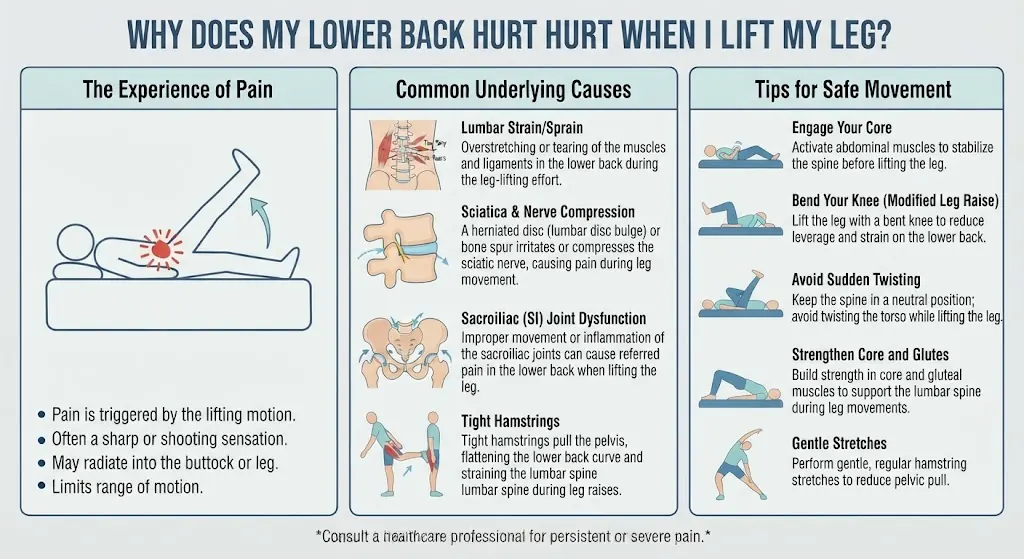
Lower back pain during leg lifting often occurs because the movement places tension on muscles, joints, or nerves around the lumbar spine. The most likely explanation depends on whether the pain is local or travels down the leg, whether it began suddenly, and which movements make it worse.
Common possibilities include:
| Possible cause | What you might notice | Clues that may help distinguish it |
|---|---|---|
| Muscle strain | Aching, tightness, or sharp pain in the lower back | Pain after lifting, bending, exercise, or an awkward movement |
| Sciatica or nerve irritation | Pain extending into the buttock or leg, sometimes with tingling | Symptoms may worsen when raising a straight leg |
| Herniated disc | Lower back pain with possible radiating leg pain or numbness | Symptoms can be aggravated by certain spinal positions or coughing |
| Spinal joint irritation | Localized pain with particular movements | Twisting, bending, or extending the back may trigger discomfort |
| Hip-related problem | Pain around the groin, hip, or front of the thigh | Raising the knee or rotating the hip may be uncomfortable |
These patterns overlap, so symptoms alone cannot confirm a diagnosis. For a broader overview, see what causes lower back pain and how different conditions may produce lower back pain symptoms.
Why Does Lifting a Straight Leg Hurt More Than Bending the Knee?
Lifting a straight leg stretches structures around the lower back, hip, hamstrings, and sciatic nerve. If a nerve root is irritated, this movement may reproduce pain that travels from the back into the buttock and down the leg. Clinicians use a similar movement, called the straight-leg raise test, to assess possible nerve irritation, but it cannot identify the cause by itself.
| Pain pattern | What it may suggest |
|---|---|
| Pain stays in the lower back | Muscle, joint, or other mechanical irritation |
| Pain travels down one leg | Possible nerve irritation or sciatica |
| Stretching discomfort mainly behind the thigh | Tight hamstrings or other soft-tissue tension |
| Pain around the groin or front of the hip | Possible hip-related irritation |
Do not repeatedly raise your leg to test yourself. Stop any movement that causes sharp pain, spreading symptoms, or new tingling.
Can Sciatica or a Herniated Disc Cause This Pain?
Yes. Sciatica can cause pain that travels from the lower back or buttock into one leg, sometimes reaching the foot. It may also cause burning, tingling, numbness, or weakness. A herniated disc is one possible cause because disc material can irritate or compress a nearby nerve root.
Learn more about the common causes of sciatica and the early symptoms of sciatica. You can also compare a herniated disc with sciatica to understand why these terms describe different things: a disc problem may cause nerve symptoms, while sciatica describes a pattern of radiating pain.
Pain alone does not prove that a disc is damaged. Some people have disc changes on imaging without symptoms, so clinicians interpret scans alongside the history and physical examination.
What Can You Do at Home?
If the pain is mild, started after ordinary activity, and is not accompanied by warning signs, try these measures:
-
Modify the movement. Bend your knee rather than keeping your leg straight when getting dressed or moving in bed.
-
Keep moving gently. Take short walks or change positions regularly instead of staying in bed for prolonged periods.
-
Use comfortable heat or cold. Apply a wrapped heat pack or cold pack for short periods, protecting your skin.
-
Avoid painful stretching. Do not force your leg upward or push through radiating pain.
-
Adjust activity temporarily. Reduce heavy lifting, deep bending, and vigorous exercise if they aggravate symptoms.
These steps align with general approaches to relieving back pain at home. If you are unsure whether to use a cold pack or heat, review heat or ice for back pain.
Gentle movement is usually preferable to prolonged bed rest, but the right activity depends on your symptoms. See guidance on whether to rest or keep moving with lower back pain and whether stretching helps lower back pain. Stop an exercise if it causes increasing pain, numbness, or weakness.
When Should You Seek Medical Care?
Monitor at home
Mild discomfort that improves with position changes and does not interfere significantly with walking may be monitored briefly if no warning signs are present.
Arrange a medical evaluation
Contact a healthcare professional if the pain persists, repeatedly returns, travels down your leg, limits daily activities, or comes with new tingling or numbness. Seek earlier evaluation after an injury or if you have fever, unexplained weight loss, a history of cancer, or other significant health risks. Guidance on when to see a doctor for lower back pain can help you decide your next step.
Seek emergency care
Get emergency medical help for new difficulty urinating, loss of bladder or bowel control, numbness around the groin or anus, or severe or rapidly worsening weakness, particularly in both legs. These can signal serious nerve compression. Review the emergency warning signs of back pain.
How Is the Cause Diagnosed?
A clinician will ask when the pain started, which leg movements trigger it, and whether symptoms spread below the knee. The examination may include checking your walking, muscle strength, sensation, reflexes, hip movement, and response to selected movements.
| Evaluation | Why it may be useful |
|---|---|
| Physical examination | Assesses movement, strength, sensation, and reflexes |
| MRI | May identify disc problems or nerve compression when imaging is warranted |
| Other tests | May be considered when injury, infection, or another condition is suspected |
An MRI is not automatically necessary for pain during leg lifting. Imaging decisions depend on the examination, warning signs, symptom progression, and whether the results would change treatment. See when lower back pain may need an MRI.
Frequently Asked Questions
1. Why does my lower back hurt when I lift my leg while lying down?
This may result from muscle or joint irritation or sensitivity around a spinal nerve. Pain that travels down the leg deserves particular attention.
2. Can a herniated disc cause lower back pain when lifting my leg?
Yes. A herniated disc can irritate a nerve and trigger back or radiating leg pain, but this symptom alone cannot confirm a disc problem.
3. What if my back hurts and my leg feels numb?
Numbness can indicate nerve involvement. Arrange medical evaluation, especially if it is new or worsening; lower back pain with leg numbness should not be ignored.
4. What if lifting my leg causes weakness?
New or progressive weakness needs prompt medical assessment. Severe or rapidly worsening weakness requires emergency evaluation; see lower back pain with leg weakness.
5. Should I do exercises when lifting my leg hurts?
Avoid movements that reproduce sharp or radiating pain. A clinician or physical therapist can help select appropriate exercises for lower back pain.
6. Can physical therapy help?
Physical therapy may help improve movement, strength, and function when appropriate for the underlying cause. A treatment plan should account for any nerve symptoms or other warning signs.
7. How long does this pain last?
Mild mechanical pain may improve over days to weeks, while nerve-related symptoms can persist longer. Seek assessment if symptoms worsen or fail to improve; guidance on how long lower back pain can last can provide additional context.
8. Should I stop lifting my leg completely?
You do not necessarily need to avoid all leg movement. Modify painful activities temporarily, keep comfortable movement within your limits, and avoid repeatedly testing the painful range.
9. Which doctor should I see?
A primary care clinician is a reasonable starting point for persistent or unexplained pain. Depending on the findings, you may need physical therapy or a specialist; learn what type of doctor treats back pain.
10. What is the quickest way to relieve the pain?
There is no single method that works for every cause. Gentle activity, comfortable heat or cold, and temporarily avoiding aggravating movements may help; see ways to get lower back pain relief quickly.
The Bottom Line
Lower back pain when lifting your leg can stem from muscle strain, joint irritation, hip problems, or nerve irritation such as sciatica. Modify painful movements, stay gently active when comfortable, and seek medical evaluation for persistent symptoms or new neurological changes. Emergency warning signs require immediate care.
Disclaimer: This article is provided for educational and informational purposes only.