A heavy feeling in your lower back can feel like pressure, fullness, tightness, or a dull ache across the area just above your hips. You might notice it after standing for a long time, sitting at a desk, walking, or waking up in the morning. Sometimes, the sensation makes your back feel tired or weighed down even when the pain is mild or absent.
Lower back heaviness does not automatically mean you have a serious spinal problem. Muscle fatigue, prolonged positions, and reduced movement are common possibilities, but persistent pressure or heaviness can sometimes be associated with nerve irritation or problems outside the spine. The location, duration, accompanying symptoms, and activities that affect the sensation all help determine whether it needs medical evaluation.
Understanding why your lower back feels heavy can help you choose appropriate self-care and recognize when to seek help. This guide explains common causes, what you can safely try at home, how long symptoms may last, and which warning signs should not be ignored.
What Does a Heavy Feeling in the Lower Back Mean?
Lower back heaviness describes a sensation rather than a specific medical diagnosis. It may occur with muscle tension, stiffness, aching, or a feeling that your back is working harder than usual to support your body.
The sensation can be localized to one side or spread across the lower back. Some people notice it mainly while standing or sitting, while others experience it after activity or during rest. These differences can offer clues, but heaviness alone cannot identify the underlying cause.
What Causes Lower Back Heaviness?
Several conditions and everyday factors may contribute to a heavy feeling in the lower back.
| Possible cause | What you might notice | Helpful clue |
|---|---|---|
| Muscle fatigue or strain | Aching, tightness, or a weighed-down feeling | Begins after lifting, exercise, bending, or prolonged activity |
| Prolonged sitting or standing | Stiffness or pressure that builds over time | Changes after adjusting position or moving |
| Reduced activity and muscle conditioning | Back feels tired during ordinary tasks | Symptoms appear during activities that require sustained effort |
| Nerve irritation | Heaviness accompanied by tingling, numbness, or leg symptoms | Sensations may travel into the buttock or leg |
| Joint or spinal conditions | Recurrent stiffness or discomfort | Symptoms persist or are influenced by particular movements |
| Non-spinal causes | Back discomfort with other symptoms | May occur alongside urinary, abdominal, pelvic, or systemic symptoms |
1. Muscle fatigue, tension, or strain
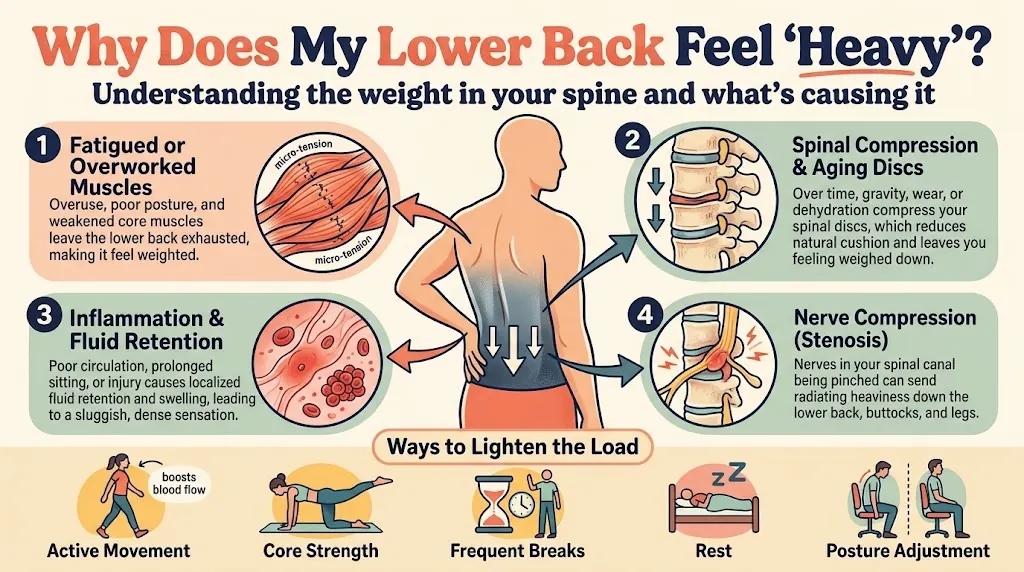
The muscles supporting your spine can become fatigued after repeated bending, lifting, housework, exercise, or maintaining one position for too long. A mild strain may also cause tenderness, stiffness, or discomfort when changing positions.
If the heaviness started after unusual physical activity, a muscular cause is possible. However, symptoms that worsen, recur frequently, or do not improve should not automatically be attributed to muscle fatigue. See what causes back pain for a broader overview of possible explanations.
2. Prolonged sitting, standing, or poor movement habits
Remaining in one position can make the lower back feel tired or stiff. Sitting without movement breaks, standing for long periods, and repeatedly bending forward may aggravate symptoms in some people.
If the sensation develops mainly while upright, lower back pain when standing for a long time may help you understand how sustained standing can affect the back. Symptoms after sitting may have different triggers, including muscle fatigue or sensitivity to particular positions.
3. Nerve irritation or spinal conditions
A heavy sensation may sometimes occur alongside nerve-related symptoms. For example, irritation of a nerve in the lower spine can cause pain, tingling, numbness, or weakness that extends into the buttock or leg. A herniated disc or spinal narrowing may contribute in some cases, but heaviness by itself does not establish either condition.
Pay attention to whether symptoms travel beyond your lower back. New or worsening neurological symptoms deserve medical assessment, especially when weakness affects walking or daily activities.
4. Other possible causes
Not every sensation in the lower back originates in the muscles or spine. Depending on its location and accompanying symptoms, discomfort may sometimes be related to urinary tract or kidney problems, digestive conditions, or pelvic conditions.
For example, constipation and back pain may occur together, although constipation does not explain every episode of back discomfort. Fever, painful urination, abdominal pain, unusual bleeding, or other new symptoms can help a clinician determine whether another cause needs investigation.
What Makes Lower Back Heaviness Worse?
The pattern of your symptoms can help you identify possible triggers.
| Pattern | Possible explanation | What to observe |
|---|---|---|
| Heaviness builds during sitting | Sustained posture or muscle fatigue | Whether standing and moving changes it |
| Heaviness follows lifting or bending | Muscle strain or irritated tissues | Whether the activity was new or unusually strenuous |
| Heaviness appears with walking or standing | Load-sensitive back symptoms or, sometimes, spinal narrowing | Whether sitting or leaning forward changes symptoms |
| Heaviness occurs with leg tingling or weakness | Possible nerve involvement | Which leg is affected and whether symptoms are progressing |
| Heaviness persists at rest or keeps worsening | Several possible causes requiring assessment | Duration, night symptoms, and other health changes |
These patterns are clues, not diagnostic tests. Avoid repeatedly provoking symptoms to see what happens.
How Can You Relieve a Heavy Feeling in Your Lower Back at Home?
If symptoms are mild, began after ordinary activity, and are not accompanied by warning signs, conservative measures may help.
- Change positions regularly. Break up long periods of sitting or standing with brief, comfortable movement.
- Keep moving gently. Short walks and normal daily activities within your tolerance are often preferable to prolonged bed rest. Stop or modify activities that clearly worsen symptoms.
- Try heat or cold. A wrapped cold pack may help after a recent strain, while gentle heat may ease muscle tightness. Protect your skin and avoid sleeping with a heating pad. The choice depends on what feels helpful.
- Reduce strenuous activity temporarily. Avoid heavy lifting, forceful twisting, or movements that sharply increase symptoms while your back settles.
- Review your sitting and sleeping setup. A comfortable chair, supportive sleeping position, and regular movement breaks may reduce aggravation.
For more practical strategies, see how to relieve back pain at home. If gentle activity is comfortable, exercises for lower back pain may offer ideas, but stop any movement that causes increasing pain, numbness, or weakness.
Do not assume that aggressive stretching is necessary. If a movement makes the heaviness worse, ease off rather than pushing through it.
How Long Does Lower Back Heaviness Last?
The duration depends on the cause. Mild muscle fatigue may settle within a few days, while a strain can take longer. Symptoms related to recurring activity patterns or an underlying condition may persist until the contributing factor is addressed.
| Symptom pattern | General expectation | Recommended approach |
|---|---|---|
| Mild symptoms after unusual activity | May improve over several days | Modify activity and monitor changes |
| Symptoms that recur with sitting, standing, or lifting | May continue if the trigger remains | Adjust the activity and seek advice if recurring |
| Symptoms that persist or interfere with daily life | May need clinical evaluation | Arrange a healthcare appointment |
| Symptoms with progressive weakness or emergency warning signs | Should not be managed by waiting for recovery | Seek urgent or emergency care as appropriate |
If the heaviness is not improving over one to two weeks, keeps returning, or interferes with sleep, work, or walking, consider arranging a medical evaluation sooner rather than relying on a fixed timeline. For more context, see how long lower back pain should last.
When Should You Worry About Lower Back Heaviness?
Symptoms you can usually monitor
Mild heaviness that follows activity, improves with changing positions, and occurs without other concerning symptoms may be monitored briefly while you use gentle self-care.
Symptoms that need medical evaluation
Arrange an appointment if the sensation persists, repeatedly returns, becomes more intense, affects daily activities, or occurs with unexplained weight loss, fever, urinary symptoms, or persistent night discomfort. A clinician may ask about the onset, activity triggers, medical history, and any symptoms affecting your abdomen, pelvis, or legs.
Symptoms requiring urgent or emergency care
Seek emergency care for new loss of bladder or bowel control, difficulty starting urination or inability to urinate, numbness around the groin or inner thighs, or severe or progressive leg weakness. These can signal serious nerve compression.
Get urgent medical help for severe back symptoms after a major accident or fall, or back discomfort accompanied by chest pain, difficulty breathing, fainting, or severe abdominal pain. Do not delay care to try home remedies if these symptoms occur. See when back pain is an emergency for additional warning signs.
What Will a Doctor Check?
A clinician will usually begin by asking when the heaviness started, where you feel it, what makes it better or worse, and whether you have leg, urinary, abdominal, or other symptoms. A physical examination may assess movement, strength, sensation, and reflexes.
Imaging is not automatically necessary for every episode of lower back discomfort. Whether tests are appropriate depends on your symptoms, examination findings, medical history, and concern for a specific underlying condition.
Frequently Asked Questions
1. Can your lower back feel heavy without pain?
Yes. Muscle fatigue, stiffness, and prolonged positioning can create a heavy or tired sensation without sharp pain. Persistent or unexplained heaviness still deserves attention, particularly if other symptoms develop.
2. Is lower back heaviness a sign of a herniated disc?
It can occur alongside disc-related symptoms, but heaviness alone is not enough to identify a herniated disc. Pain traveling into the leg, tingling, numbness, or weakness may warrant further evaluation.
3. Why does my lower back feel heavy when I stand?
Standing for a long time can fatigue the muscles that support your spine. If heaviness repeatedly develops with standing, especially alongside leg symptoms or difficulty walking, discuss the pattern with a healthcare professional.
4. Can sitting all day cause lower back heaviness?
Prolonged sitting may contribute to stiffness and muscle fatigue, particularly when you rarely change positions. Regular movement breaks and a comfortable sitting setup may help.
5. Can stress make my lower back feel heavy?
Stress can increase muscle tension and influence how strongly you experience discomfort. However, it should not be assumed to be the cause without considering physical and medical explanations.
6. Should I stretch when my lower back feels heavy?
Gentle movement may help if it feels comfortable, but forceful stretching can aggravate some causes of back symptoms. Stop any stretch that increases discomfort or causes tingling, numbness, or weakness.
7. Is walking good for lower back heaviness?
Short, comfortable walks may help reduce stiffness associated with prolonged sitting. If walking consistently worsens the sensation or causes leg weakness, numbness, or significant pain, stop and seek medical advice.
8. Can kidney problems cause a heavy feeling in the lower back?
Kidney or urinary tract problems can cause pain or discomfort in the back or side, sometimes with fever, nausea, or urinary changes. The location and associated symptoms matter, so seek medical assessment if these features occur.
9. When should I see a doctor for lower back heaviness?
Make an appointment if the sensation persists, keeps returning, worsens, or limits normal activities. Seek emergency care for new bladder or bowel dysfunction, saddle-area numbness, or severe or progressive weakness.
10. Can lower back heaviness go away on its own?
Mild symptoms related to temporary muscle fatigue or positioning may improve with time and activity adjustments. Symptoms that persist, worsen, or occur with warning signs need assessment rather than indefinite self-treatment.
Conclusion
A heavy feeling in your lower back can be related to muscle fatigue, prolonged positioning, or other conditions, and the sensation alone cannot determine the cause. Try comfortable movement, adjust activities that aggravate it, and monitor how symptoms change. Seek medical advice if the heaviness persists or interferes with daily life, and get urgent care for neurological or other emergency warning signs.
Disclaimer: This article is provided for educational and informational purposes only.