Standing for a long time can leave your lower back aching, tight, heavy, or tired. You might feel fine when you first stand but notice increasing discomfort after 20 minutes, an hour, or several hours of cooking, working, shopping, or waiting. If you regularly experience lower back pain when standing, the pattern can provide clues about what may be aggravating your back.
Standing-related back pain does not automatically mean you have a serious spine problem. Muscle fatigue, prolonged posture, reduced movement, joint irritation, or certain spinal conditions can all contribute. However, pain that is severe, persistent, progressively worsening, or accompanied by numbness or weakness deserves medical evaluation.
This article explains why your lower back may hurt after prolonged standing, what symptoms can help distinguish common causes, what you can safely try at home, and when it makes sense to see a clinician.
Why Does Standing for a Long Time Cause Lower Back Pain?
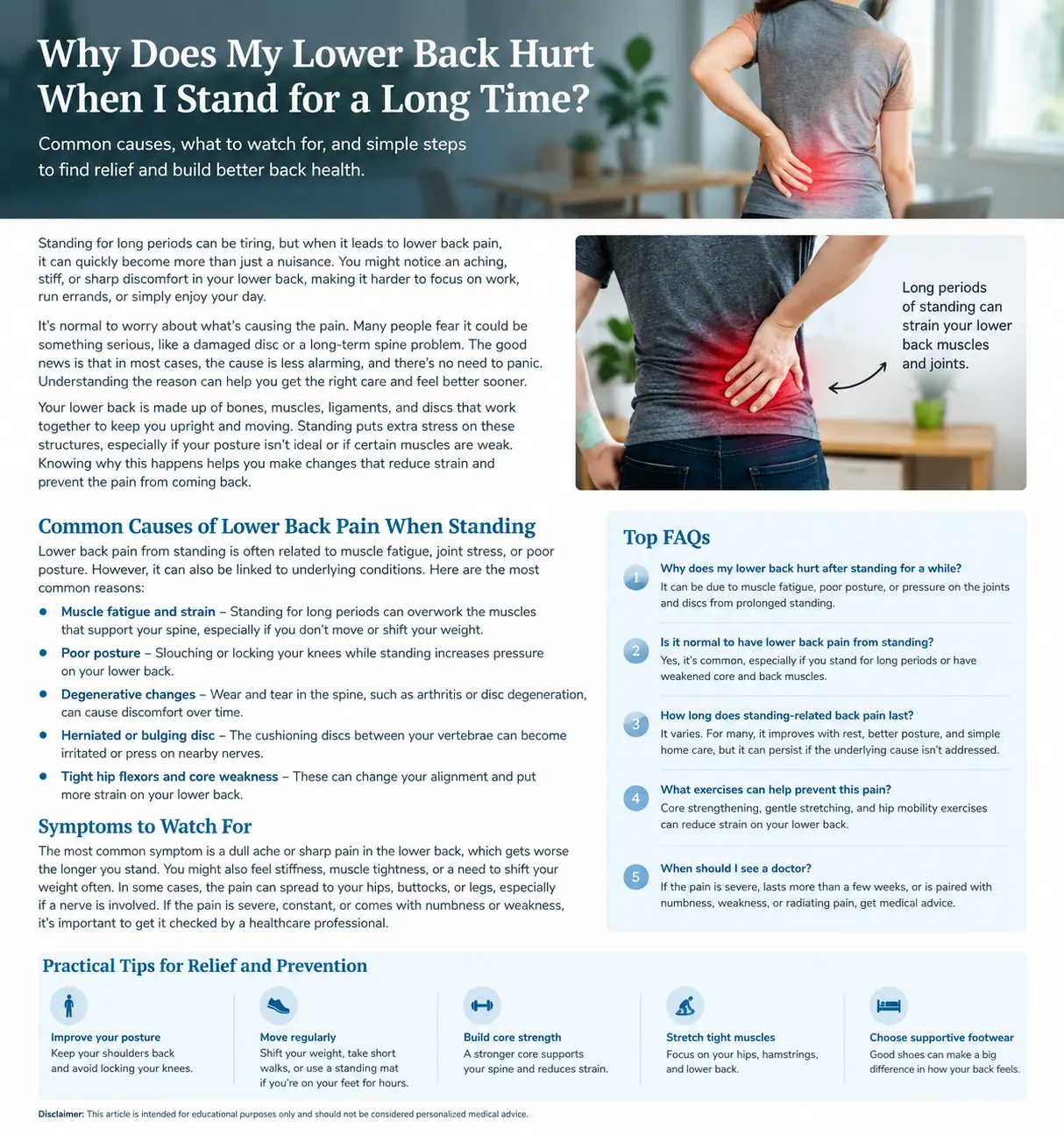
Prolonged standing keeps the muscles and joints around your lower back working continuously to maintain your posture. If you remain in one position without shifting, those tissues may become fatigued or irritated.
The discomfort may also be related to the way you stand. Leaning backward, locking your knees, shifting your weight mostly onto one leg, or repeatedly extending your lower back can increase stress on certain structures.
Common possibilities include:
| Possible contributor | What you may notice | What may aggravate it |
|---|---|---|
| Muscle fatigue or strain | Aching, tightness, soreness | Long periods without movement |
| Joint irritation | Localized lower-back discomfort | Standing, extension, twisting |
| Disc-related pain | Back pain sometimes with buttock or leg symptoms | Certain positions, bending, lifting |
| Spinal stenosis | Back or leg discomfort with prolonged standing/walking | Standing or walking for longer periods |
| Poor standing mechanics | General aching or heaviness | Leaning, uneven weight distribution |
Understanding the broader pattern of lower back pain causes can help put standing-related symptoms into context.
What Does Standing-Related Lower Back Pain Feel Like?
The sensation varies depending on the underlying cause. Some people describe a dull ache that gradually builds, while others notice stiffness, pressure, burning, or pain that spreads toward the buttocks.
Pay attention to whether sitting or lying down changes the symptoms. Also note whether walking makes the pain better or worse, and whether symptoms travel into one or both legs.
| Symptom pattern | What it can suggest |
|---|---|
| Ache that builds gradually while standing | Muscle fatigue or mechanical back pain |
| Pain relieved fairly quickly by changing position | Position-sensitive mechanical pain |
| Back pain with buttock discomfort | Several possible mechanical or nerve-related causes |
| Pain extending into the leg | Possible nerve involvement |
| Leg heaviness or pain mainly with standing/walking | Can occur with spinal stenosis |
For example, back pain and leg heaviness can occur when spinal nerves are affected, although symptoms alone cannot establish the cause.
Could Spinal Stenosis Cause Lower Back Pain When Standing?
Yes. Spinal stenosis can cause lower back discomfort, leg pain, heaviness, numbness, or weakness that becomes more noticeable with standing or walking. Some people find relief when sitting or bending slightly forward.
The pattern is more important than any single symptom. If standing consistently produces leg symptoms that improve after sitting or leaning forward, discuss this pattern with a clinician. You can also learn about what spinal stenosis feels like to understand the typical symptom pattern.
Standing vs. Sitting vs. Walking
| Activity | What to notice |
|---|---|
| Standing | Does pain steadily increase with time? |
| Sitting | Does sitting reduce symptoms quickly or only gradually? |
| Walking | Does movement help, or does walking reproduce the pain? |
| Bending forward | Does leaning forward change symptoms? |
| Lying down | Does resting flat provide meaningful relief? |
This information can be useful during a medical assessment because activity-specific symptoms may provide more information than simply describing your pain as “lower back pain.”
What Can You Do if Your Lower Back Hurts After Standing?
You generally do not need to remain completely still. Changing position regularly can reduce the amount of time your back spends under the same mechanical load.
Try alternating standing with short periods of walking or sitting. Avoid locking your knees, and periodically shift your weight rather than maintaining one rigid posture.
If symptoms are mild and there are no warning signs, how to relieve back pain at home offers practical home-care strategies that can be adapted to your situation.
Gentle movement may also be useful. exercises for lower back pain can help you understand which types of movement may be appropriate, but stop an exercise that clearly increases pain or produces new neurological symptoms.
Should You Keep Standing or Sit Down When Pain Starts?
You do not necessarily have to stop every activity as soon as mild discomfort appears. Instead, use symptoms as a cue to change position, take a brief walking break, or sit when appropriate.
A useful approach is to avoid repeatedly pushing through progressively worsening pain. If standing for 60 minutes causes significant symptoms, shorter standing periods with movement breaks may be more tolerable.
For people who spend much of the day at a desk or workstation, is a standing desk better for lower back pain explains why simply replacing sitting with continuous standing is not necessarily the answer.
When Should You See a Doctor for Lower Back Pain From Standing?
Consider medical evaluation if the pain keeps returning, interferes with work or daily activities, lasts despite reasonable self-care, or progressively becomes easier to trigger.
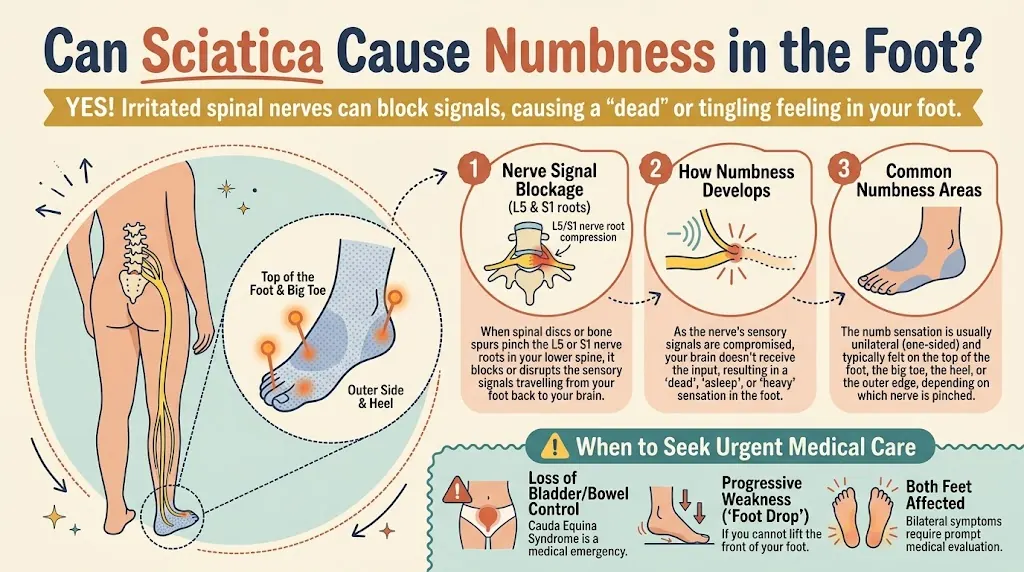
You should also seek evaluation if back pain occurs with leg numbness, tingling, weakness, significant changes in walking, or pain that repeatedly travels down the leg. When to see a doctor for back pain provides additional guidance on persistent symptoms.
Warning Signs
Usually reasonable to monitor:
Mild aching that occurs after prolonged standing and improves with changing position or resting, provided it is not progressively worsening.
Arrange medical evaluation:
Persistent or recurrent pain, increasing limitations, leg symptoms, unexplained weakness, or symptoms that are not improving.
Seek urgent or emergency care:
Severe back pain accompanied by new significant leg weakness, loss of bladder or bowel control, numbness around the groin or inner thighs, or other sudden neurological changes. These symptoms require prompt assessment; see when back pain is an emergency for more detail.
Does Standing-Related Back Pain Mean You Need an MRI?
Not necessarily. Imaging decisions depend on the duration and severity of symptoms, examination findings, injury history, neurological symptoms, and whether there are warning signs.
MRI can be useful when a clinician suspects a specific structural or nerve-related problem, but many uncomplicated episodes of lower back pain are initially managed without imaging. If your symptoms persist or have concerning features, you can discuss does lower back pain need an MRI with your healthcare professional.
Frequently Asked Questions
1. Why does my lower back hurt after standing for an hour?
Prolonged standing can fatigue the muscles that support your spine and may aggravate sensitive joints or other structures. The exact reason depends on your symptoms, posture, activity level, and medical history.
2. Why does my lower back hurt when I stand but feel better when I sit?
Some mechanical conditions are more sensitive to prolonged standing or spinal extension. Relief with sitting can also occur with certain patterns of spinal stenosis, particularly when leg symptoms are present.
3. Can poor posture cause lower back pain when standing?
Yes. Holding your pelvis or spine in an uncomfortable position for a long time can increase muscular fatigue and mechanical stress. However, posture is only one possible contributor and does not explain every case.
4. Is walking better than standing for lower back pain?
It depends on the cause. Some people feel better when they walk because movement prevents prolonged static loading, while others experience more pain with walking, particularly when certain spinal conditions are present.
5. Why does my back hurt more the longer I stand?
Pain that progressively builds can occur when muscles and other tissues become fatigued or when a particular standing position repeatedly aggravates sensitive structures. Taking movement breaks can help determine whether prolonged static posture is contributing.
6. Can a herniated disc cause pain when standing?
It can. A herniated disc may cause lower back pain and, when a nerve is irritated, symptoms such as leg pain, tingling, numbness, or weakness. Can a herniated disc cause lower back pain explains this relationship in more detail.
7. Should I rest if my lower back hurts from standing?
Brief rest can be helpful when pain flares, but prolonged bed rest is generally not necessary for most uncomplicated back pain. In many situations, comfortable movement and gradual return to normal activities are preferable to avoiding all activity.
8. How long is too long to have lower back pain?
There is no single number that applies to everyone. Pain that persists, repeatedly returns, or interferes substantially with normal activities should be discussed with a healthcare professional; see how long should back pain last for additional context.
9. Can lower back pain from standing be prevented?
You may reduce symptoms by changing positions regularly, avoiding prolonged rigid postures, maintaining appropriate activity, and gradually improving strength and mobility. Prevention strategies should be adjusted if a specific medical condition is contributing to the pain.
10. What if my lower back pain keeps coming back whenever I stand?
Recurring symptoms deserve attention rather than repeatedly treating each episode in isolation. A clinician can assess your activity pattern, neurological symptoms, mobility, and other factors to determine whether further evaluation is appropriate. Why does my back pain keep coming back? addresses recurring back pain more specifically.
Conclusion
Lower back pain after prolonged standing can result from muscle fatigue, posture-related stress, joint irritation, disc-related problems, or conditions such as spinal stenosis. Notice whether your symptoms change with sitting, walking, bending, or resting, because the pattern can help guide evaluation.
For mild symptoms, changing positions, taking movement breaks, and maintaining comfortable activity may help. If pain is persistent, recurrent, progressively worsening, or accompanied by neurological symptoms, arrange a medical evaluation rather than continuing to push through it.
Disclaimer: This article is provided for educational and informational purposes only.