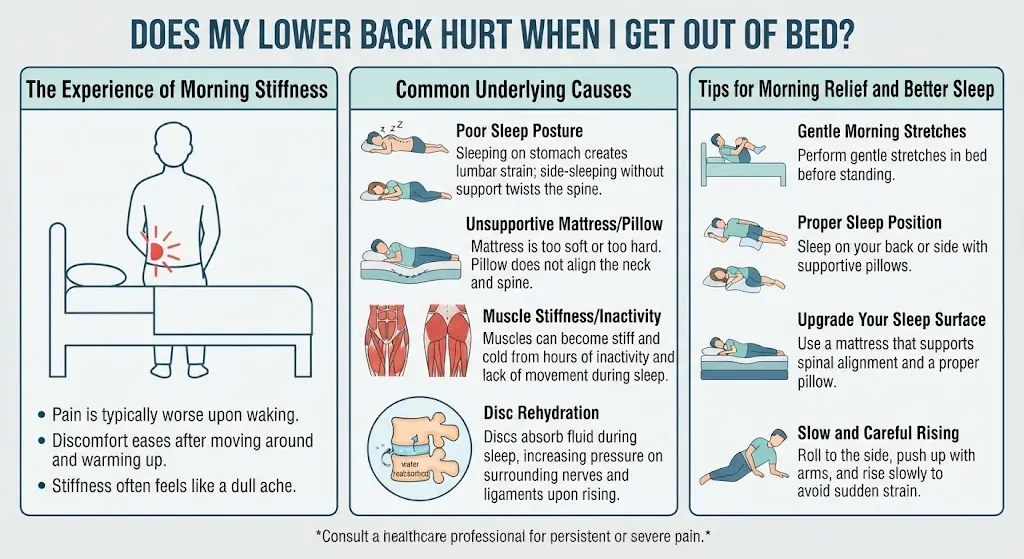
Waking up with lower back pain can make the first few minutes of the day surprisingly difficult. You may feel stiff when you roll over, notice pain as soon as you sit up, or experience a sharp twinge when you stand beside the bed. Lower back pain getting out of bed is common, but the pattern and what happens after you start moving can provide useful clues.
Morning back pain does not automatically mean your mattress is damaging your spine or that you have a serious condition. Sleeping position, prolonged inactivity, muscle stiffness, joint irritation, and certain spinal problems can all contribute. Pain that is severe, persistent, worsening, or accompanied by neurological symptoms should be evaluated rather than dismissed as ordinary morning stiffness.
This article explains why your lower back may hurt when you get out of bed, how to distinguish common patterns, what you can do during the first part of the morning, and when persistent morning pain deserves medical attention.
Why Does My Lower Back Hurt When I Get Out of Bed?
Your back remains relatively still for several hours while you sleep. When you suddenly roll, sit up, bend forward, and stand, stiff muscles and joints are exposed to movement after a prolonged period of inactivity.
Your sleeping position can also influence symptoms. Staying in one position for hours may increase stiffness, while an unsupported or uncomfortable position may aggravate an already sensitive area.
| Morning pattern | Possible explanation |
|---|---|
| Stiffness that improves after moving | Prolonged inactivity, muscle or joint stiffness |
| Pain when first bending forward | Position-sensitive mechanical pain |
| Pain when twisting or rolling over | Irritated muscles or joints |
| Pain extending into the buttock or leg | Possible nerve-related symptoms |
| Morning stiffness that lasts a long time | May warrant evaluation, particularly if recurrent |
If you are trying to understand the broader picture, lower back pain causes can help explain other possible contributors.
Can Your Sleeping Position Cause Morning Lower Back Pain?
Yes. Sleeping with the spine or pelvis in an uncomfortable position for several hours may contribute to morning stiffness or discomfort. However, there is no single sleeping position that works for everyone.
Some people find side sleeping more comfortable with appropriate support between the knees, while others prefer sleeping on their back with support under the knees. If you repeatedly wake with pain, reviewing best sleeping positions for lower back pain may help you experiment with positions without assuming that one posture is universally best.
Your mattress may also affect comfort, particularly if it is excessively soft, excessively firm, or no longer providing adequate support. See best mattress for back pain for factors to consider when evaluating your sleep surface.
Why Does My Back Hurt When I First Stand Up in the Morning?
The transition from lying down to standing combines several movements: rolling, pushing yourself upright, bending, and loading the spine. If your lower back is stiff, that sequence can temporarily increase discomfort.
The important question is what happens afterward.
| What happens after getting up? | What it may indicate |
|---|---|
| Pain eases within minutes | Stiffness after prolonged inactivity may contribute |
| Pain improves with gentle movement | Movement-sensitive stiffness is possible |
| Pain stays severe throughout the day | Further evaluation may be appropriate |
| Pain spreads into the leg | Possible nerve involvement |
| Pain repeatedly worsens with certain movements | A mechanical trigger may be present |
If your symptoms are specifically triggered by the transition from sitting or lying to standing, compare them with lower back pain getting out of a chair.
Why Is My Back Stiff in the Morning but Better During the Day?
Morning stiffness that gradually improves after you begin moving can occur because tissues have been inactive overnight. In some people, however, prolonged or pronounced morning stiffness can be associated with inflammatory conditions rather than simple mechanical stiffness.
The duration matters. A few minutes of stiffness is different from substantial stiffness that repeatedly lasts for a long period or occurs with other symptoms. morning back pain that improves during the day explores that pattern in more detail.
What Should You Do When Your Lower Back Hurts After Waking?
Avoid jumping immediately from bed into strenuous activity. Instead, give your back a short transition period.
You can try:
- Rolling onto your side before pushing yourself upright.
- Sitting at the edge of the bed for a moment before standing.
- Walking gently around the room.
- Avoiding sudden deep bending immediately after waking.
- Using comfortable, gradual movement rather than forcing a stretch.
If mild symptoms persist after getting up, how to relieve back pain at home provides additional conservative strategies.
Gentle exercise can also be useful for some people. exercises for lower back pain explains movement options, but an exercise should not cause escalating pain, new numbness, or weakness.
Can Heat Help Morning Lower Back Stiffness?
Some people find warmth comfortable when their back feels stiff after waking. Heat may temporarily reduce the sensation of muscle tightness, although it does not identify or treat the underlying cause.
If you use a heating pad, avoid excessive temperature and prolonged direct contact with the skin. For guidance on choosing between different approaches, see heat or ice for back pain.
When Could Morning Back Pain Be a Sign of Something More?
Persistent morning pain can have many explanations, including ordinary mechanical back pain, disc-related problems, arthritis, or other spinal conditions. The presence of leg symptoms can make nerve involvement more relevant.
For example, a disc problem can cause lower back pain with or without symptoms traveling into the leg. what does a herniated disc feel like describes common symptom patterns.
Spinal stenosis can also produce back or leg symptoms, although it more typically becomes problematic with standing or walking. what does spinal stenosis feel like explains how its symptoms can differ from other causes.
Symptoms That Need Attention
| Situation | What to do |
|---|---|
| Mild morning stiffness that improves with movement | Monitor and use comfortable activity |
| Recurrent or persistent morning pain | Arrange a medical evaluation |
| Pain with leg numbness, tingling, or weakness | Seek clinical assessment |
| Severe pain after significant trauma | Prompt medical evaluation |
| New bladder/bowel problems or numbness around the groin | Seek emergency care |
You should also seek medical advice if pain repeatedly wakes you, keeps worsening, or does not improve despite reasonable self-care. when back pain is an emergency covers more serious warning signs.
Frequently Asked Questions
1. Why does my lower back hurt only when I get out of bed?
The transition from lying down to standing places movement and load on tissues that have been relatively inactive overnight. Stiff muscles, joints, or other sensitive structures may hurt during this transition and then improve once you start moving.
2. Why is my lower back stiff every morning?
Repeated morning stiffness can be related to sleeping position, prolonged inactivity, mechanical back problems, or other conditions. If it is persistent or lasts a long time, discuss the pattern with a healthcare professional.
3. Should I stretch my lower back immediately after waking?
Gentle movement may be more comfortable than aggressive stretching immediately after waking. If stretching consistently increases your pain, stop and consider discussing appropriate exercises with a clinician or physical therapist.
4. Is morning lower back pain caused by my mattress?
A mattress can affect comfort and sleep position, but morning back pain cannot automatically be attributed to the mattress. Consider the relationship between your symptoms, sleeping position, mattress condition, and how you feel after changing positions.
5. Why does my back hurt when I roll over in bed?
Rolling requires spinal rotation and movement of the pelvis and trunk. If certain muscles, joints, or other structures are sensitive, that movement may reproduce pain. See lower back pain turning in bed for this specific pattern.
6. Can sciatica cause lower back pain in the morning?
Sciatica can cause lower back or buttock pain along with symptoms affecting the leg, although not everyone with sciatica has significant back pain. Numbness, tingling, or weakness can provide additional clues about nerve involvement.
7. Is it better to rest or move when my back hurts after waking?
For many uncomplicated episodes of back pain, prolonged bed rest is not necessary. Comfortable movement and gradually returning to normal activity may be preferable, while activities that clearly worsen symptoms should be modified.
8. When should morning lower back pain be checked by a doctor?
Arrange an evaluation if the pain is persistent, recurrent, increasingly severe, interferes with normal activities, or occurs with neurological symptoms. New significant weakness, bladder or bowel changes, or numbness around the groin requires urgent attention.
9. Can arthritis cause lower back pain in the morning?
Arthritis can contribute to back pain and stiffness, particularly as people age. However, morning pain alone cannot establish that arthritis is the cause.
10. What if my lower back pain keeps coming back every morning?
Recurring symptoms are worth discussing with a healthcare professional rather than repeatedly treating the morning pain without determining why it occurs. Keeping track of your sleeping position, symptom duration, activities, and whether movement improves the pain can make the evaluation more useful.
Conclusion
Lower back pain when getting out of bed can result from overnight inactivity, sleeping position, muscle or joint stiffness, or an underlying back condition. Pay attention to how long the stiffness lasts, whether movement improves it, and whether symptoms extend into your buttocks or legs.
Start the morning with gradual movement rather than sudden bending or strenuous exercise. If the pain is persistent, repeatedly worsening, or accompanied by numbness, weakness, bladder or bowel changes, or other warning signs, seek appropriate medical evaluation.
Disclaimer: This article is provided for educational and informational purposes only.