Yoga is not supposed to leave you struggling with everyday movements. Mild muscle soreness can occur after unfamiliar activity, but recurring, sharp, or worsening pain deserves attention. Your symptoms do not automatically mean you have injured your spine, and they should not be dismissed as a normal part of getting more flexible.
Understanding why your lower back hurts after yoga can help you distinguish ordinary muscle soreness from movement-related irritation or a problem that needs medical evaluation. The right response depends on when the pain begins, which movements trigger it, how severe it is, and whether symptoms extend into your buttocks or legs.
Why Does Yoga Cause Lower Back Pain?
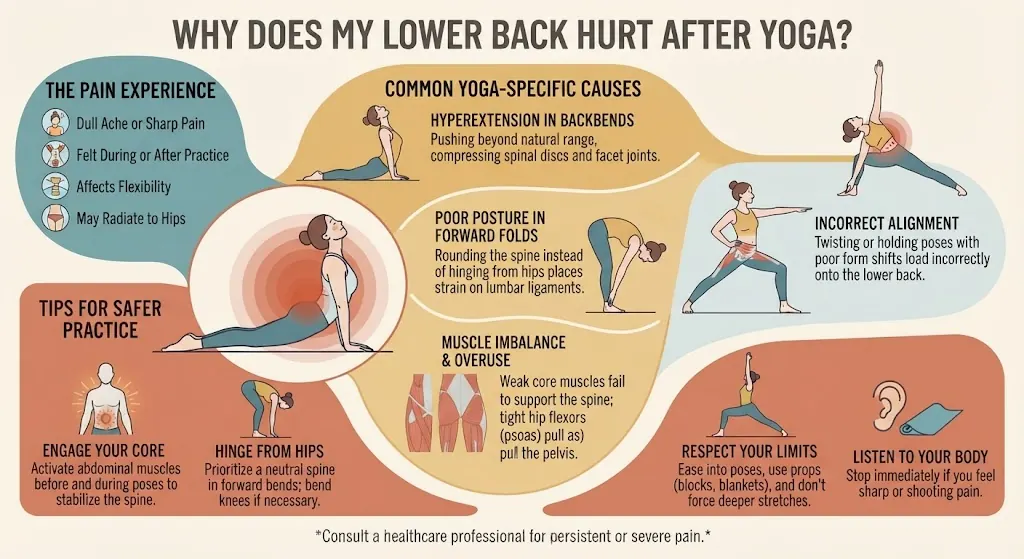
Yoga-related lower back pain often develops when a pose places more load on the lumbar spine than your muscles, joints, or other tissues can comfortably tolerate. Limited hip mobility, fatigue, excessive stretching, repeated spinal bending, and sudden increases in practice intensity may all contribute.
The lower back supports the trunk while allowing you to bend, extend, rotate, and transfer force between your upper and lower body. During yoga, the hips, abdominal muscles, glutes, and back muscles work together to control these movements. If a pose exceeds your current capacity, some tissues may become irritated.
Common explanations include:
-
Muscle strain or soreness: Unfamiliar poses, prolonged holds, or repeated transitions can fatigue or overload the muscles supporting your spine.
-
Excessive forward bending: Deep folds may increase discomfort when you repeatedly bend through your lower back instead of distributing movement through your hips.
-
Overarching the lower back: Deep backbends can aggravate sensitive spinal joints or other tissues, particularly when you push beyond a comfortable range.
-
Twisting beyond your comfortable range: Forceful or prolonged rotations may irritate the back when combined with bending or poor control.
-
Limited hip mobility: When your hips do not move comfortably, your lower back may compensate during folds, lunges, and seated poses.
-
Existing back or nerve irritation: A previously sensitive disc, joint, or nerve may become symptomatic during certain positions.
These are possible explanations, not diagnoses. General information about what causes back pain can help put yoga-related symptoms into context.
Which Yoga Poses Can Make Lower Back Pain Worse?
Certain poses may aggravate your lower back, especially when you force the range of motion, hold a position through pain, or repeat movements that already trigger symptoms.
| Yoga pose or movement | Why it may aggravate your back | Safer modification |
|---|---|---|
| Seated Forward Fold | Deep bending may irritate sensitive tissues | Bend your knees and hinge gently at the hips |
| Downward-Facing Dog | Limited shoulder or hip mobility may increase back strain | Bend your knees and shorten your stance |
| Cobra or Upward-Facing Dog | Excessive lower-back arching may provoke pain | Use a lower, gentle lift or skip the pose |
| Revolved Triangle or deep twists | Combined rotation and bending may be uncomfortable | Reduce the rotation and keep the movement controlled |
| Bridge Pose | Pushing too high may cause excessive back extension | Lift only as far as comfortable without arching excessively |
| Plow Pose | Deep spinal flexion and neck positioning may be unsuitable for some people | Avoid it while symptoms are active unless a qualified clinician advises otherwise |
These modifications are starting points, not universally safe prescriptions. If a movement reproduces sharp pain, radiating symptoms, or increasing discomfort, stop rather than trying to stretch through it.
How Can You Tell Whether It Is Muscle Soreness or an Injury?
The timing and character of your symptoms can offer clues, but they cannot reliably establish the cause on their own.
| Feature | More consistent with ordinary soreness | More concerning for irritation or injury |
|---|---|---|
| Sensation | Dull ache, tenderness, stiffness | Sharp, catching, burning, or shooting pain |
| Timing | Often develops after unfamiliar exercise | May begin suddenly during a pose or worsen afterward |
| Location | Usually around the muscles used | May remain localized or spread into the buttock or leg |
| Movement | Loosens somewhat with gentle activity | Specific movements may repeatedly provoke pain |
| Trend | Gradually improves over several days | Persists, worsens, or interferes increasingly with daily activities |
Ordinary delayed-onset muscle soreness commonly begins 12–24 hours after unfamiliar exercise and often peaks within 24–72 hours. However, pain that follows yoga does not necessarily represent muscle soreness, and there is no single recovery timeline that applies to every back problem.
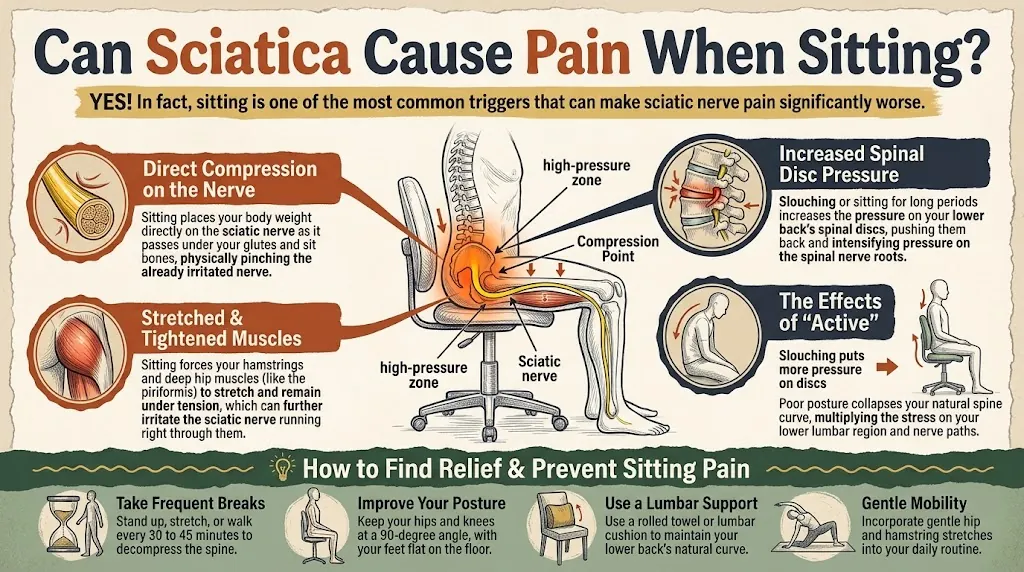
If pain travels down your leg, particularly with tingling, numbness, or weakness, discuss possible nerve involvement with a clinician. You can also review what sciatica feels like and what causes it.
What Should You Do When Your Lower Back Hurts After Yoga?
The safest first step is to stop the movements that trigger pain, reduce the intensity of your activity, and monitor how symptoms change.
1. Modify activity instead of forcing a stretch
Pause deep forward folds, backbends, and twists that reproduce your symptoms. You do not necessarily need complete bed rest; gentle walking and comfortable everyday movement may help you remain active if they do not worsen the pain.
Guidance on whether to rest or keep moving with lower back pain can help you choose an appropriate level of activity.
2. Use heat or ice if it helps
A wrapped cold pack may ease discomfort after a recent flare, while gentle heat may help with muscle tightness. Apply either for approximately 15–20 minutes at a time, protect your skin, and avoid falling asleep with a heating pad or ice pack in place.
Neither option is essential, and neither treats every underlying cause. See whether heat or ice is better for back pain for guidance on choosing between them.
3. Return to yoga gradually
Once everyday movements are comfortable and symptoms are improving, consider restarting with shorter sessions, gentler poses, and less extreme ranges of motion. Tell your instructor about your symptoms and ask for modifications rather than attempting to match the flexibility of other participants.
For persistent symptoms, physical therapy for lower back pain may help you identify movement limitations and build strength safely.
What does research say about yoga and back pain?
Research suggests yoga can help some adults with chronic lower back pain, but it is not risk-free and does not suit every person or every pose.
A 2022 systematic review included 21 trials involving 2,223 adults. Compared with no exercise, yoga produced small improvements in pain and back-related function after three months. Compared with other back-focused exercise, it showed little or no difference in back-related function. Increased back pain was among the reported adverse effects.
| Research finding | What it means for your practice |
|---|---|
| Small improvements compared with no exercise | Yoga may help when appropriately adapted |
| Similar functional outcomes to other exercise | Yoga is not necessarily better than conventional exercise |
| Back pain reported as an adverse effect | Modify or stop poses that aggravate symptoms |
| Evidence varies in certainty | Individual response and clinical assessment matter |
These findings concern adults with chronic, nonspecific low back pain. They do not establish the cause of new pain after an individual yoga session.
When Should You Seek Medical Care?
Symptoms you can usually monitor
Mild soreness that improves steadily, without neurological symptoms or other warning signs, may be monitored at home. Reduce the intensity of exercise and avoid movements that make the pain worse.
Symptoms that need medical evaluation
Arrange an appointment if pain is severe, repeatedly returns after yoga, interferes with sleep or daily activities, or does not improve over the following days to weeks. Seek assessment sooner if you have fever, unexplained weight loss, a history of cancer, or increasing pain with no clear explanation.
Symptoms requiring emergency care
Seek emergency care for new loss of bladder or bowel control, difficulty urinating, numbness around the groin or saddle area, or rapidly worsening weakness in one or both legs. These symptoms can indicate serious nerve compression. More guidance is available on when back pain is an emergency.
Frequently Asked Questions
1. Is it normal for my lower back to hurt after yoga?
Mild muscle soreness can happen after unfamiliar poses or a more demanding session. Sharp, worsening, or recurring pain should not be treated as a normal sign of progress.
2. Why does my lower back hurt after forward bends?
Deep forward bends can aggravate sensitive back tissues, especially when you force the movement or repeatedly round your lower spine. Try a smaller range and bend your knees, stopping if pain persists.
3. Should I stop doing yoga if my back hurts?
Pause poses that reproduce your pain rather than pushing through them. If symptoms are significant or persistent, seek medical advice before resuming your usual routine.
4. Can stretching make lower back pain worse?
Yes. Stretching can aggravate symptoms when it is forceful, prolonged, or unsuitable for the underlying cause. Gentle movement should remain comfortable; see whether stretching helps lower back pain.
5. How long does lower back pain after yoga last?
Mild exercise-related soreness often settles within a few days. Pain that persists, worsens, or limits normal activity warrants assessment rather than relying on a fixed recovery deadline.
6. Should I use heat or ice after yoga?
Either may help temporarily, depending on your symptoms and preference. Protect your skin and stop if either application increases discomfort.
7. Can yoga help existing lower back pain?
It may provide modest benefits for some people with chronic low back pain when adapted to their abilities. Research does not show that yoga is consistently better than other forms of exercise.
8. Can a herniated disc cause pain after yoga?
A herniated disc can cause back pain or nerve symptoms, but pain after yoga alone cannot confirm a disc problem. A clinician can assess your symptoms and determine whether further testing is appropriate.
9. When can I return to my usual yoga class?
Consider returning gradually when everyday movement is comfortable and symptoms are improving. Start with shorter sessions and modified poses, and stop if pain returns.
10. Should I see a doctor if yoga causes leg pain or numbness?
Yes, particularly if symptoms travel down the leg or include tingling or numbness. New or worsening weakness, saddle-area numbness, or bladder or bowel changes require urgent evaluation.
The Bottom Line
Lower back pain after yoga may result from muscle soreness, excessive bending, back extension, twisting, or irritation of existing tissues. Stop painful movements, adjust your practice, and return gradually as symptoms improve. Persistent pain or neurological symptoms deserve medical assessment, and emergency warning signs should never be ignored.
For ongoing discomfort, a useful next step is to review exercises for lower back pain and discuss an individualized plan with a qualified healthcare professional.
Disclaimer: This article is provided for educational and informational purposes only.