Pain that moves away from the spine can be confusing. Hip or leg pain does not automatically mean a herniated disc is responsible, and the location of discomfort alone cannot confirm which structure is affected. Muscle problems, joint conditions, and other nerve disorders can produce similar symptoms.
Understanding where herniated disc pain travels can help you recognize common symptom patterns, understand why nerve-related pain spreads, and know when to seek medical care. The pattern of pain, associated sensory changes, and any weakness are important clues, but a clinical assessment is needed to determine the cause.
Where Does Herniated Disc Pain Usually Travel?
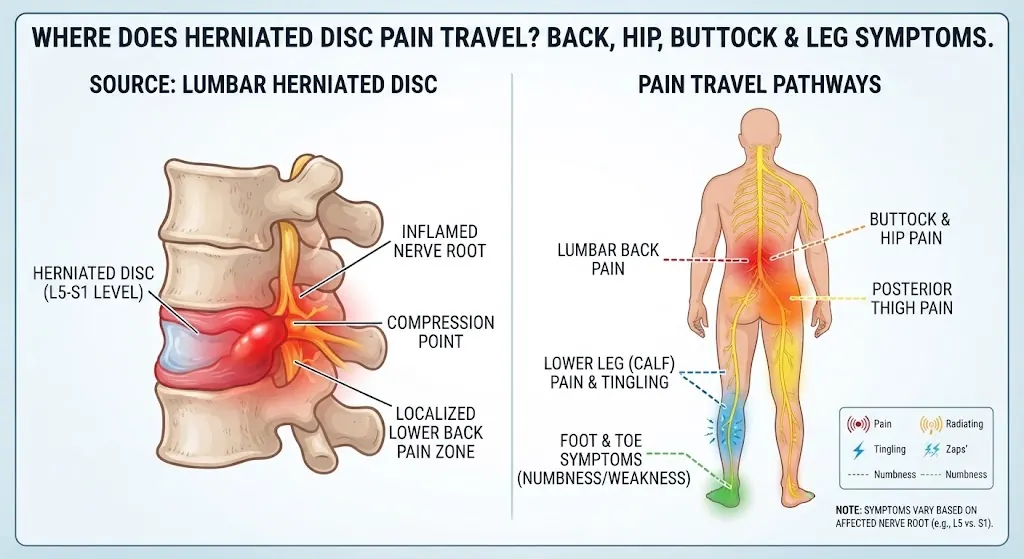
Herniated disc pain can remain near the spine or spread into the buttock, hip, thigh, calf, or foot. The pattern depends on the disc’s location and which nerve root, if any, is affected.
A herniated disc occurs when material from an intervertebral disc protrudes through a weakened area of its outer layer. If this material irritates or compresses a nearby nerve root, symptoms may travel along the nerve’s distribution.
Common patterns include:
-
Lower back to buttock: Pain may begin near the lumbar spine and spread into one buttock.
-
Back or buttock to thigh: Discomfort may extend down the back or side of the thigh.
-
Thigh to calf or foot: Nerve irritation can produce shooting pain, tingling, or numbness farther down the leg.
-
Neck to shoulder and arm: A cervical disc herniation can cause symptoms that travel into the shoulder, arm, or hand.
-
Back pain without radiating symptoms: A herniated disc may cause localized discomfort without clear nerve-related leg pain.
For a closer look at the characteristic sensations, see what a herniated disc feels like.
How Does the Location of a Herniated Disc Affect Pain?
The location of a herniated disc helps explain which body areas may develop symptoms. However, the exact pattern varies, and overlapping nerve pathways mean that pain location cannot reliably identify the affected disc on its own.
| Disc or nerve area | Where symptoms may travel | Other possible symptoms |
|---|---|---|
| Upper lumbar nerves | Lower back, groin, front of thigh | Hip-flexion or knee-straightening weakness |
| Mid-to-lower lumbar nerves | Buttock, outer thigh, shin, or top of foot | Tingling, numbness, or difficulty lifting the foot |
| Lower lumbar or sacral nerves | Buttock, back of thigh, calf, sole or outer edge of foot | Weakness when pushing off or standing on tiptoes |
| Cervical discs in the neck | Neck, shoulder, arm, hand, or fingers | Arm weakness, tingling, or reduced sensation |
These are general patterns, not a diagnostic map. A disc can affect different nerve roots depending on its size and direction, and some herniations cause no symptoms at all.
Can a Herniated Disc Cause Hip or Buttock Pain?
Yes. A lumbar herniation can irritate nerve roots that send pain into the buttock or hip region. Some people have prominent buttock pain before they notice symptoms farther down the leg.
However, hip arthritis, tendon problems, and irritation around the sacroiliac joint can cause similar discomfort. If you have hip pain associated with possible sciatica, the location and triggers of the pain are useful details to discuss with a clinician.
Pain concentrated in the buttock without leg symptoms may also have other explanations. Learn more about buttock pain without pain down the leg.
Can a Herniated Disc Cause Leg Pain Without Back Pain?
Yes. A herniated disc may irritate a nerve root enough to cause pain in the leg even when lower back pain is mild or absent. The pain may feel sharp, electric, burning, or shooting, and can occur with numbness or tingling.
Leg pain alone does not prove that a disc is herniated. Circulation problems, peripheral nerve conditions, and hip or leg disorders can also cause pain, so persistent or unexplained symptoms deserve evaluation.
For a more focused explanation, see how a herniated disc can cause leg pain without back pain.
What Do Tingling, Numbness, and Weakness Mean?
Pain is only one possible symptom of nerve irritation. Affected nerves also carry sensory signals and control muscles, so a herniated disc can cause changes in feeling or movement.
| Symptom | What you may notice | Why it matters |
|---|---|---|
| Tingling | Pins and needles in the leg or foot | May indicate sensory nerve irritation |
| Numbness | Reduced feeling in part of the leg or foot | May reflect altered nerve function |
| Weakness | Difficulty lifting the foot, climbing stairs, or rising onto tiptoes | Can indicate impaired motor nerve function |
| Pain with movement or coughing | A shooting sensation triggered by certain actions | May occur when an irritated nerve is mechanically aggravated |
For example, tingling in the leg associated with sciatica may follow a different distribution from foot pain linked to sciatica. Similarly, foot numbness associated with sciatica deserves attention if it is new, persistent, or spreading.
Weakness is especially important. If you notice leg weakness that may be related to sciatica, arrange a medical assessment. Rapidly worsening weakness requires urgent evaluation.
Is It a Herniated Disc, Sciatica, or a Pinched Nerve?
These terms are related, but they do not mean the same thing.
-
Herniated disc: A structural change in the cushion between spinal bones.
-
Sciatica: A symptom pattern involving pain that travels along the sciatic nerve pathway, commonly into the buttock and leg.
-
Pinched nerve: A general term for a nerve that is compressed or irritated.
A herniated disc can cause sciatica when it irritates a relevant nerve root. Sciatica can also arise from causes other than a herniated disc.
The distinction matters because herniated disc versus sciatica compares a structural condition with a symptom pattern, while herniated disc versus pinched nerve explains the difference between a specific disc problem and broader nerve compression.
A bulging disc can also irritate a nerve, although a bulge and a herniation are not identical. See whether a bulging disc can cause sciatica for more detail.
How Can You Tell Whether the Pain Comes From a Herniated Disc?
Symptoms can suggest nerve irritation, but no single pain pattern reliably confirms a herniated disc. A clinician considers your medical history, symptom distribution, strength, sensation, reflexes, and how movement affects the pain.
Other conditions can produce overlapping symptoms. For example, spinal stenosis symptoms may include leg discomfort, numbness, or heaviness during walking. A comparison of a herniated disc, bulging disc, and muscle strain can help explain why these conditions are not interchangeable.
An examination may include checking whether you can lift your foot, walk on your heels or toes, and feel light touch in different parts of your leg. If you have lower back pain with leg numbness, tell your clinician when it started, where it travels, and whether it is changing.
Do You Need an MRI?
Not everyone with suspected disc-related pain needs immediate imaging. An MRI may be appropriate when symptoms persist despite initial care, significant neurological changes develop, or the result would affect treatment decisions.
An MRI can show disc herniations and other structural changes, but an abnormal finding does not automatically mean it is causing your pain. Your symptoms and examination must be considered alongside the scan.
Learn more about when lower back pain needs an MRI and what an MRI can show about lower back pain.
What Helps Relieve Herniated Disc Pain?
Treatment depends on symptom severity, the degree of nerve involvement, and how long symptoms have lasted. Many people improve with nonsurgical care, which may include maintaining tolerable activity, guided physical therapy, and clinician-recommended pain relief.
Avoid prolonged bed rest, heavy lifting that aggravates symptoms, and exercises that increase radiating leg pain. Do not start or combine medications without considering their risks, particularly if you have other health conditions or take prescription medicines.
Recovery varies. Many people improve over several weeks, although nerve symptoms can take longer. Read about how long a herniated disc takes to heal.
Surgery may be considered when significant symptoms persist despite appropriate nonsurgical treatment or when serious nerve compression requires urgent intervention. Leaving a symptomatic disc problem unassessed can delay appropriate care, so understand what can happen if a herniated disc goes untreated.
When Is Herniated Disc Pain an Emergency?
Seek emergency care immediately if you have:
-
New difficulty urinating or inability to empty your bladder.
-
Loss of bladder or bowel control.
-
New numbness around the groin, genitals, or inner thighs.
-
Severe or rapidly worsening weakness in one or both legs.
These symptoms can indicate cauda equina syndrome, a rare but serious condition involving compression of nerve roots. Do not wait to see whether the symptoms improve overnight. For additional guidance, see when back pain is an emergency.
Arrange a prompt medical appointment for persistent radiating pain, recurring numbness, or symptoms that interfere with walking, sleep, or daily activities.
Treatment Options at a Glance
| Treatment | Main purpose | Important consideration |
|---|---|---|
| Gentle activity | Maintain mobility | Modify movements that worsen leg symptoms. |
| Physical therapy | Improve strength and movement | Exercises should match your symptoms. |
| Medication | Reduce pain or inflammation | Benefits and risks vary by medication. |
| Surgery | Relieve significant nerve compression | Usually considered for specific clinical indications. |
A herniated disc can also contribute to lower back pain without prominent leg symptoms. Treatment should address your actual symptoms rather than the scan result alone.
Frequently Asked Questions
1. Where does herniated disc pain travel?
It may spread from the back into the buttock, thigh, calf, or foot. The pattern depends on which nerve is affected.
2. Can pain travel to the hip?
Yes. Disc-related nerve irritation can cause hip or buttock pain, but hip joint and muscle conditions can feel similar.
3. Can a herniated disc cause foot pain?
Yes. Irritation of certain lower spinal nerve roots can cause pain, tingling, or numbness in the foot.
4. Can leg pain occur without back pain?
Yes. Nerve irritation may cause prominent leg symptoms even when back pain is mild or absent.
5. Does pain location identify the affected disc?
Not reliably. A clinician needs to consider the symptom pattern alongside examination findings.
6. Does coughing make disc pain worse?
It can. Coughing, sneezing, or straining may aggravate symptoms in some people with nerve irritation.
7. How long does radiating pain last?
Many people improve over several weeks, but recovery varies. Persistent or worsening symptoms warrant reassessment.
8. Can a herniated disc heal without surgery?
Many symptomatic herniations improve with nonsurgical treatment. Severe nerve compression or persistent disabling symptoms may require other treatment.
9. When should I get an MRI?
Imaging may be appropriate when symptoms persist, neurological deficits develop, or the result would change treatment.
10. What symptoms require emergency care?
New bladder or bowel dysfunction, numbness around the groin, or rapidly worsening leg weakness requires emergency assessment.
Conclusion
Herniated disc pain may travel from the spine into the buttock, hip, thigh, calf, or foot, but symptoms vary according to the affected nerve. Track where the pain travels and whether numbness or weakness develops, and seek clinical assessment for persistent or worsening symptoms. Emergency warning signs require immediate care.
Disclaimer: This article is provided for educational and informational purposes only.