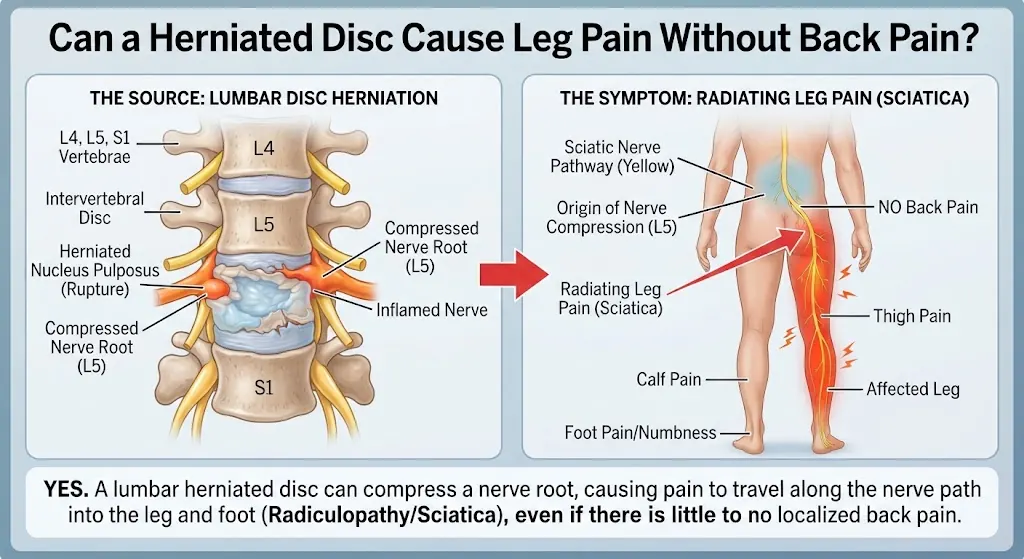
Yes, a herniated disc can cause leg pain without noticeable back pain. When disc material irritates or compresses a nearby nerve root, symptoms may travel into the leg even if the back itself does not hurt. However, leg pain alone does not prove that you have a herniated disc, because several other conditions can produce similar symptoms.
Understanding how a herniated disc affects nerves, which symptoms may accompany leg pain, and when medical care is necessary can help you decide what to do next. This guide explains possible causes, diagnosis, treatment options, recovery expectations, and warning signs that should not be ignored.
How Can a Herniated Disc Cause Leg Pain Without Back Pain?
A herniated disc can cause leg pain without back pain when the displaced disc material irritates a nerve root in the lower spine. These nerves carry signals into the buttocks and legs, so irritation can produce symptoms away from the spine.
The discs between your vertebrae act as cushions. Each disc has a soft inner portion surrounded by a tougher outer layer. If the outer layer weakens or develops a tear, some inner material can protrude outward and sometimes affect a nearby nerve.
This may cause radicular pain, often described as sharp, shooting, burning, or electric-like pain that travels along a nerve pathway. When the sciatic nerve roots are involved, the symptoms are commonly described as sciatica.
A disc problem does not always cause pain at the site of the disc. The irritated nerve may be responsible for most of the symptoms, which helps explain why someone can experience substantial leg pain with little or no back discomfort.
For a closer look at what a herniated disc feels like, consider both the location of your pain and whether you have accompanying sensory or muscle changes.
What Does Herniated Disc Leg Pain Feel Like?
Herniated disc-related leg pain varies depending on which nerve root is affected and how severely it is irritated. Some people experience pain alone, while others notice tingling, numbness, or weakness.
Common symptoms include:
-
Sharp or shooting pain extending from the buttock into the thigh or lower leg.
-
Burning sensations or electric-like jolts in one leg.
-
Tingling or pins-and-needles sensations in the foot or toes.
-
Numbness in a particular area of the leg.
-
Weakness when lifting the foot, straightening the knee, or pushing off while walking.
-
Symptoms that worsen with prolonged sitting, coughing, sneezing, or certain movements.
Pain may affect the buttock, back of the thigh, calf, or foot. The precise distribution depends on the nerve involved, and symptoms do not always follow a textbook pattern.
| Symptom | What it may indicate |
|---|---|
| Shooting pain down one leg | Possible irritation of a spinal nerve root |
| Tingling or pins and needles | Possible sensory nerve involvement |
| Numbness in the foot or leg | Altered sensation that warrants assessment if persistent or new |
| Difficulty lifting the foot or toes | Possible motor nerve involvement |
| Leg pain without back pain | A spinal nerve problem is possible, but other causes must be considered |
These symptoms can occur with sciatica caused by a herniated disc, but they are not specific enough to confirm the diagnosis without an appropriate assessment.
What Else Can Cause Leg Pain Without Back Pain?
A herniated disc is one possible explanation, but other conditions can cause similar symptoms. The location, triggers, and associated symptoms help a clinician narrow down the possibilities.
| Possible cause | Typical clues |
|---|---|
| Sciatica from a spinal nerve | Shooting pain, tingling, or numbness traveling down the leg |
| Peripheral nerve compression | Symptoms concentrated in a particular area, such as the foot |
| Spinal stenosis | Leg pain, heaviness, or numbness that may worsen with standing or walking |
| Hip problems | Pain around the groin, outer hip, or thigh, often affected by hip movement |
| Circulation problems | Leg discomfort associated with activity, sometimes with changes in temperature or skin color |
The distinction between a herniated disc and sciatica is important: a herniated disc is a structural problem, whereas sciatica describes a pattern of symptoms. A bulging disc that irritates the sciatic nerve may also produce leg pain, while spinal stenosis symptoms can overlap.
Do not assume that leg pain comes from your spine if it occurs with a swollen, warm leg, sudden shortness of breath, or a cold, pale foot. These symptoms may indicate a circulation problem requiring urgent evaluation.
How Is a Herniated Disc Diagnosed Without Back Pain?
A clinician usually starts with your symptom history and a physical and neurological examination. They may check muscle strength, sensation, reflexes, walking ability, and whether particular movements reproduce your symptoms.
An MRI may be appropriate when symptoms persist despite conservative treatment, when significant weakness is present, or when imaging would change treatment decisions. It is not routinely necessary for every new episode of leg pain.
Understanding what an MRI can show about the lower back can help you prepare for that discussion.
One important limitation is that disc abnormalities can appear on MRI in people who have no symptoms. A scan must be interpreted alongside the examination and the location of your pain, rather than treated as proof that the disc is causing your symptoms.
What Can You Do to Relieve Leg Pain From a Herniated Disc?
Treatment often begins with conservative care, provided there are no emergency warning signs.
-
Keep moving gently as tolerated instead of remaining in bed for extended periods. Guidance on whether to rest or keep moving with lower back pain can help you find a sensible balance.
-
Temporarily modify lifting, deep bending, and movements that consistently intensify leg symptoms. Avoid exercises that may aggravate lower back pain.
-
Discuss pain-relief medicines with a clinician or pharmacist, particularly if you have kidney disease, stomach ulcers, take blood thinners, or have other medical conditions.
-
Consider supervised rehabilitation. A clinician can determine whether physical therapy may help lower back pain and tailor exercises to your symptoms.
Many people improve without surgery. However, persistent disabling pain or progressive neurological symptoms may require specialist assessment.
When Should You Seek Medical Care?
Arrange a medical appointment if leg pain persists, repeatedly returns, interferes with walking or sleep, or is accompanied by ongoing numbness. New or worsening weakness deserves prompt assessment.
Seek emergency care immediately for new loss of bladder or bowel control, difficulty urinating, numbness around the groin or inner thighs, or rapidly progressing weakness in one or both legs. These may indicate serious nerve compression. See when back pain is an emergency for additional warning signs.
Frequently Asked Questions
1. Can a herniated disc cause leg pain without any back pain?
Yes. A herniated disc can irritate a nerve root that sends pain signals into the leg, even when the lower back itself does not hurt.
2. Can leg pain be the first sign of a herniated disc?
Yes. Leg symptoms may be the most noticeable feature, although some people experience back pain first or have both symptoms together.
3. Can a herniated disc cause foot numbness?
Yes. Nerve irritation can cause numbness or tingling in the foot or toes. New or progressive sensory changes should be medically assessed.
4. Can a herniated disc cause leg weakness?
Yes. Compression or irritation of a nerve root can affect muscle strength. New or worsening weakness needs prompt medical evaluation.
5. How long does leg pain from a herniated disc last?
Symptoms may improve over several weeks, but recovery varies. Persistent pain, worsening symptoms, or neurological changes may require further assessment.
6. Does a herniated disc always show up on an MRI?
MRI can identify many disc herniations, but scan findings must match the person’s symptoms and examination. A disc abnormality on its own does not establish the cause of leg pain.
7. Can walking make herniated disc leg pain worse?
It can, depending on the affected nerve and underlying condition. Try shorter, comfortable walks and seek guidance if walking consistently worsens symptoms.
8. Does a herniated disc always need surgery?
No. Many people improve with nonsurgical treatment. Surgery may be considered for persistent disabling symptoms or significant neurological problems.
9. Can leg pain from a herniated disc occur on both sides?
It can, although symptoms often affect one side. New symptoms in both legs, especially with bladder changes or groin numbness, require emergency assessment.
10. Can a herniated disc get worse without treatment?
Symptoms can persist or worsen, but deterioration is not inevitable. Progressive weakness, spreading numbness, or changes in bladder or bowel function should never be ignored.
Conclusion
A herniated disc can cause leg pain without back pain because irritated spinal nerves may produce symptoms far from the spine. However, other conditions can cause similar discomfort, so persistent or unexplained leg pain deserves proper evaluation. Seek emergency care for bladder or bowel changes, groin numbness, or rapidly worsening weakness.
Disclaimer: This article is provided for educational and informational purposes only.