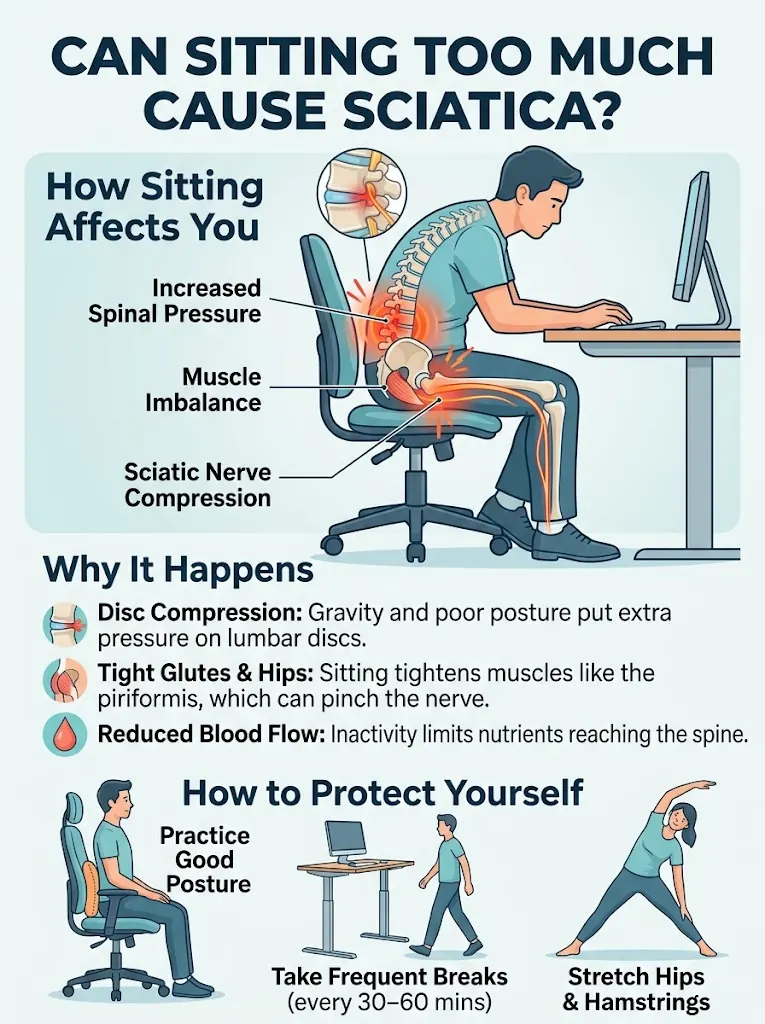
But can sitting too much actually cause sciatica? Prolonged sitting can aggravate sciatic nerve pain, but sitting alone does not necessarily cause sciatica. The underlying issue may involve a herniated disc, narrowing around spinal nerves, or another condition affecting the lower back or buttocks. Not everyone who sits for long periods develops nerve pain, and not all pain after sitting is sciatica.
Understanding the difference between a temporary sitting-related ache and possible nerve irritation can help you choose safer ways to move, adjust your workstation, and decide when to seek medical advice. This guide explains why sitting may trigger sciatica symptoms, how often to change positions, what you can do at home, and which warning signs should not be ignored.
How Can Sitting Too Much Make Sciatica Worse?
Sitting can aggravate sciatica by increasing discomfort in sensitive lower-back structures and keeping the hips and spine in one position for an extended period. Depending on the underlying cause, sitting may increase pressure on an irritated spinal nerve or worsen symptoms associated with a herniated disc.
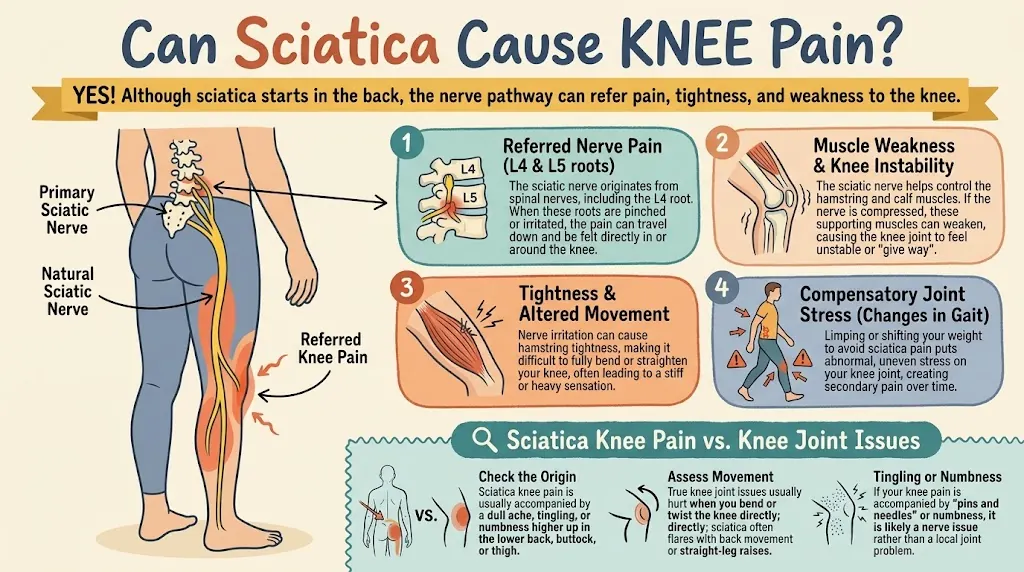
Sciatica describes pain caused by irritation or compression of nerve roots that contribute to the sciatic nerve. Symptoms commonly affect one side of the body and may travel from the lower back or buttock down the thigh, calf, or foot.
Common reasons sitting may worsen symptoms include:
-
Prolonged spinal positioning: Staying in one position for too long can aggravate sensitive tissues.
-
Disc-related nerve irritation: Sitting may increase symptoms in some people with a herniated or bulging disc.
-
Limited movement: Remaining seated reduces opportunities to change posture and move stiff joints.
-
Hip and buttock discomfort: Pressure around sensitive muscles and tissues may contribute to pain that resembles sciatica.
-
Poorly adjusted workstations: Slouching, unsupported sitting, or reaching toward a screen can increase back discomfort.
The relationship varies from person to person. If you want to understand the possible underlying causes, review these common causes of sciatica and sciatic nerve pain.
What Does Sciatica From Sitting Feel Like?
Sciatica symptoms may begin after sitting for a while or become more noticeable when you stand up after a long meeting or car ride. The discomfort can range from mild aching to sharp, burning, or shooting pain.
| Symptom | What you may notice |
|---|---|
| Buttock pain | Aching or sharp discomfort on one side |
| Pain traveling down the leg | Pain extending into the thigh or calf |
| Tingling or pins and needles | An unusual sensation in the leg or foot |
| Numbness | Reduced sensation in part of the leg or foot |
| Leg weakness | Difficulty lifting the foot or moving the leg normally |
Symptoms may improve when you change positions, but this is not a reliable way to confirm sciatica. For example, sciatica that causes tingling in the leg can reflect nerve irritation, while leg pain caused by a herniated disc without back pain can occur even when the lower back feels relatively normal.
If discomfort stays mainly in your lower back and does not travel down the leg, it may have another cause. Read about why your lower back hurts after sitting to understand how position-related back pain can differ from nerve symptoms.
How Long Should You Sit if You Have Sciatica?
There is no single medically established sitting limit that works for everyone with sciatica. Your tolerance depends on symptom severity, the underlying cause, and whether sitting increases pain, numbness, or weakness.
The practical goal is to change positions before discomfort builds. You do not need to avoid sitting completely, but you should avoid remaining in one position for unnecessarily long periods.
| Situation | Practical approach |
|---|---|
| Desk work | Try brief movement breaks every 30–60 minutes, sooner if symptoms increase |
| Long car rides | Stop safely at regular intervals to stand and walk |
| Sitting through meetings | Alternate between sitting and standing when possible |
| Relaxing at home | Change positions instead of staying on the couch for hours |
| After a flare-up | Resume comfortable daily movement gradually |
The 30–60-minute interval is a practical starting point, not a proven sciatica-specific treatment threshold. Adjust it according to your symptoms and work demands.
A Cochrane review of 10 randomized trials involving 1,923 people with acute lower-back pain, with or without sciatica, found small benefits from advice to remain active for acute lower-back pain. For sciatica specifically, staying active versus bed rest made little or no difference in pain or function in the available evidence. This supports avoiding prolonged bed rest, but it does not prove that a particular sitting-break schedule treats sciatica.
For practical workplace adjustments, explore how often to get up from sitting to prevent back pain and how to sit to avoid lower-back pain.
How Can You Relieve Sciatica From Sitting at Home?
The most useful first steps are to reduce prolonged sitting, keep moving within your tolerance, and avoid positions that consistently worsen your symptoms. You do not need to force yourself through sharp or spreading nerve pain.
1. Take short movement breaks
Stand up, walk around, or gently change position throughout the day. If walking increases your symptoms, try shorter periods or another comfortable movement rather than pushing through worsening pain. These desk exercises for sitting-related back pain may help you build more movement into your workday.
2. Adjust your sitting position
Keep your feet supported, avoid twisting toward your screen, and use a chair that supports a comfortable, relaxed posture. There is no single perfect sitting posture; changing positions regularly is often more useful than trying to hold one rigid position.
If you experience discomfort during your commute, consider how to adjust a car seat for lower-back pain and ways to prevent back pain during a long car ride.
3. Try gentle activity instead of prolonged rest
Walking or gentle exercises may help you maintain mobility, provided they do not significantly worsen your symptoms. A physical therapist can help select movements based on your symptoms and physical abilities.
For guidance, see whether walking is good for lower-back pain and exercises for lower-back pain. Avoid aggressive stretching if it sends pain farther down your leg. Learn what to avoid doing with sciatica before attempting unfamiliar exercises.
4. Use heat or cold if it helps
A wrapped cold pack may ease discomfort after an aggravating activity, while gentle heat may help relax tight muscles. Neither treatment fixes every cause of sciatica, and you should protect your skin from excessive heat or cold.
Compare heat or ice for back pain and consider other ways to relieve back pain at home.
Sitting-Related Sciatica: What Helps and What May Make It Worse?
| Approach | Potential benefit | Important limitation |
|---|---|---|
| Frequent position changes | Reduces time spent in an aggravating position | Does not treat every underlying cause |
| Gentle walking | Maintains everyday movement | May need modification if symptoms worsen |
| Ergonomic adjustments | May improve sitting comfort | No chair or posture guarantees relief |
| Guided physical therapy | Helps tailor activity and exercises | The plan depends on individual findings |
| Prolonged bed rest | May feel temporarily comfortable | Can interfere with normal activity and recovery |
Clinical guidance generally favors self-management, continued normal activities as tolerated, and individualized exercise. Medication choices require care because anti-inflammatory drugs can cause side effects, and some commonly prescribed medicines have limited evidence of benefit for sciatica. Discuss suitable options with a clinician or pharmacist rather than starting prescription medication on your own.
When Should You Seek Medical Care?
Sciatica may improve with time and conservative care, but symptoms should not automatically be blamed on sitting. Other conditions can cause back or leg pain, and some require prompt evaluation.
-
Usually monitor: Mild, familiar discomfort that improves with position changes and does not involve new weakness or other warning signs.
-
Arrange a medical appointment: Pain that persists for several weeks, keeps returning, interferes with daily activities, or worsens despite self-care. See guidance on when to see a doctor for lower-back pain.
-
Seek emergency care: New difficulty controlling your bladder or bowels, inability to urinate, numbness around the groin or saddle area, or rapidly worsening or severe weakness in the legs. These may indicate serious nerve compression. Review when back pain is an emergency.
A clinician may assess your strength, sensation, reflexes, and movement. Imaging is not routinely necessary for every episode; it may be considered when findings suggest a serious cause or the results would change treatment. If symptoms persist, physical therapy for lower-back pain may be appropriate.
Frequently Asked Questions
1. Can sitting all day cause sciatica?
Sitting for long periods can aggravate existing sciatic nerve symptoms, but it is not necessarily the underlying cause. Disc problems and other conditions affecting spinal nerves can contribute.
2. Why does sciatica hurt more when I sit?
Sitting may aggravate sensitive spinal structures or nerve roots, depending on the underlying condition. Some people find standing or walking more comfortable.
3. Can sitting on a hard chair cause sciatica?
A hard chair may increase pressure around the buttocks and make discomfort worse. However, discomfort from sitting on a hard surface does not establish that the sciatic nerve is affected.
4. Is it better to sit or stand with sciatica?
Neither position is best for everyone. Alternate between sitting, standing, and gentle walking according to your symptoms rather than remaining in one position for long periods.
5. How long is too long to sit with sciatica?
There is no universal time limit. If symptoms increase after 20 minutes, for example, take a break before that point rather than forcing yourself to meet a fixed schedule. For persistent symptoms, see how long lower-back pain can last before evaluation.
6. Should I stop working if sitting triggers sciatica?
Not necessarily. Try modifying your workstation, taking movement breaks, and alternating tasks. Seek medical advice if pain or neurological symptoms prevent you from working safely.
7. Can sciatica go away if I stop sitting so much?
Reducing prolonged sitting may help control symptoms, but it may not resolve the underlying cause. Recovery depends on what is irritating the nerve and whether appropriate treatment is needed.
8. Is sitting or sleeping worse for sciatica?
Either can aggravate symptoms, depending on the person and underlying condition. If nighttime discomfort is a problem, explore how to sleep with sciatica.
9. Can a herniated disc cause sciatica after sitting?
Yes. A herniated disc can irritate or compress a nerve root, and sitting may worsen symptoms in some people. Learn what a herniated disc feels like.
10. When should I worry about sciatica from sitting?
Seek emergency care for new bladder or bowel dysfunction, saddle-area numbness, or rapidly progressing leg weakness. Arrange routine medical evaluation for persistent, worsening, or activity-limiting symptoms.
The Bottom Line
Sitting too much can aggravate sciatica, but it does not explain every episode of back or leg pain. Change positions regularly, stay gently active as tolerated, and adjust your workstation to reduce discomfort. If symptoms persist or worsen, arrange a medical assessment, and seek emergency care for serious neurological warning signs.
Disclaimer: This article is provided for educational and informational purposes only.