Foot pain does not always mean sciatica, however. Problems involving the foot itself, peripheral nerves, circulation, or other structures can produce similar symptoms. The location of the pain, whether you have numbness or weakness, and how the symptoms began can help a healthcare professional determine what may be causing them.
Understanding how sciatica affects the foot can help you recognize common nerve-related symptoms, choose sensible self-care measures, and know when to seek medical attention. Although many cases improve without surgery, new or worsening weakness and certain other warning signs require prompt assessment.
How Can Sciatica Cause Foot Pain?
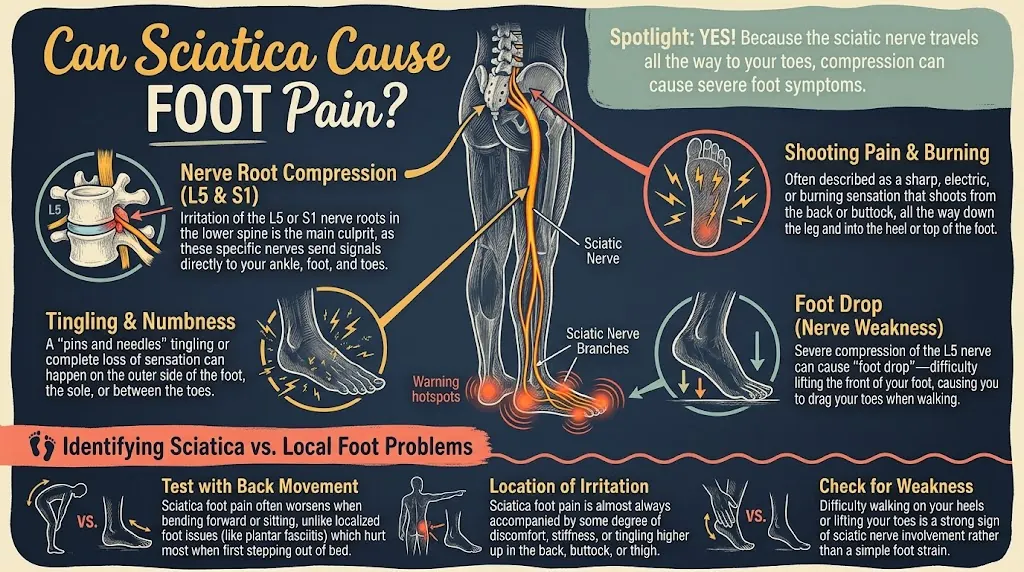
Yes. Sciatica can cause foot pain when irritation or compression of nerve roots in the lower spine affects the sciatic nerve pathway. The sciatic nerve travels from the lower back through the buttock and down the leg, with branches that supply sensation and movement in parts of the foot.
Conditions such as a herniated disc or narrowing around spinal nerves can irritate the nerve roots that contribute to the sciatic nerve. This may produce pain, tingling, numbness, or weakness along part of the leg and into the foot.
The symptoms depend partly on which nerve roots are affected. For example, irritation involving the L5 nerve root may affect sensation around the top of the foot or big toe, while S1 nerve root involvement may cause symptoms along the outer foot or sole. These patterns overlap and cannot reliably identify the affected nerve without an examination.
If you are wondering what causes sciatica and sciatic nerve pain, disc-related nerve irritation is one possible explanation, but it is not the only one.
What Does Sciatica Foot Pain Feel Like?
Sciatica-related foot pain often feels different from ordinary soreness caused by standing or walking. Nerve irritation may cause unusual sensations even when the foot looks normal.
Common symptoms include:
-
Burning or electric pain: A sharp, shooting sensation that travels down the leg into the foot.
-
Tingling or pins and needles: An unusual prickling sensation in the toes, sole, or top of the foot.
-
Numbness: Reduced sensation or a feeling that part of the foot is asleep.
-
Aching or radiating pain: Discomfort extending from the buttock or calf toward the foot.
-
Weakness: Difficulty lifting the front of the foot, raising the toes, or pushing off while walking.
Some people experience several symptoms at once. Others have only one, and not everyone with sciatica experiences obvious lower back pain.
The distinction between pain and weakness is particularly important. Pain may make movement uncomfortable, whereas true weakness means the muscles are not working normally. New weakness deserves prompt medical evaluation.
Where in the Foot Can Sciatica Cause Pain?
Sciatica can affect different parts of the foot depending on which nerve roots are irritated. The location may offer clues, but it cannot confirm the cause on its own.
| Foot location | Possible nerve-related symptoms | What else matters |
|---|---|---|
| Top of the foot | Pain, tingling, or reduced sensation | Whether you can lift your foot and toes normally |
| Big toe | Tingling, numbness, or radiating pain | Whether symptoms extend up the outer lower leg |
| Outer edge of the foot | Aching, tingling, or altered sensation | Whether the calf or buttock is also affected |
| Heel or sole | Burning, aching, or numbness | Whether symptoms also occur with standing or pressure on the foot |
| Entire foot | Diffuse tingling, pain, or numbness | Other possible nerve, circulation, or neurological causes |
Foot symptoms can overlap across nerve roots, and pain in the heel or sole can also result from local foot conditions. A clinician may compare sensation, muscle strength, reflexes, and walking ability to help determine the likely source.
Can sciatica cause foot pain without back pain?
Yes. Nerve irritation can produce pain predominantly in the leg or foot, even when the lower back does not hurt. A person may first notice tingling in the toes, burning in the foot, or discomfort extending down the calf.
However, foot pain without back pain has many possible causes. If you have persistent foot tingling associated with lower back symptoms, or unexplained numbness, a medical assessment can help distinguish nerve-root irritation from other conditions.
What Causes Sciatica Pain to Reach the Foot?
Several conditions can irritate the nerves responsible for sensation and movement in the lower leg and foot.
Herniated or bulging disc
A spinal disc can protrude and irritate a nearby nerve root. Symptoms may include radiating leg pain, tingling, numbness, or weakness. A disc abnormality on an imaging scan does not automatically mean it is causing your symptoms.
Learn what a herniated disc can feel like and why its effects can extend beyond the lower back.
Spinal stenosis
Spinal stenosis is narrowing of spaces around spinal nerves. It may cause pain, tingling, heaviness, or weakness in the legs, sometimes worsening during standing or walking and improving when sitting or bending forward.
Other nerve problems
A peripheral nerve problem, such as compression of the peroneal nerve near the knee, can cause symptoms around the top of the foot and difficulty lifting it. Diabetes and other conditions affecting peripheral nerves can also cause burning or numbness, often in both feet.
A clinician may consider whether back pain can be caused by a nerve problem when symptoms do not follow a typical muscular pattern.
How Can You Relieve Sciatica Foot Pain at Home?
Home care may help manage mild symptoms when there are no warning signs, but it cannot correct every cause of nerve irritation. The aim is to maintain comfortable movement without worsening symptoms.
1. Keep moving within your limits
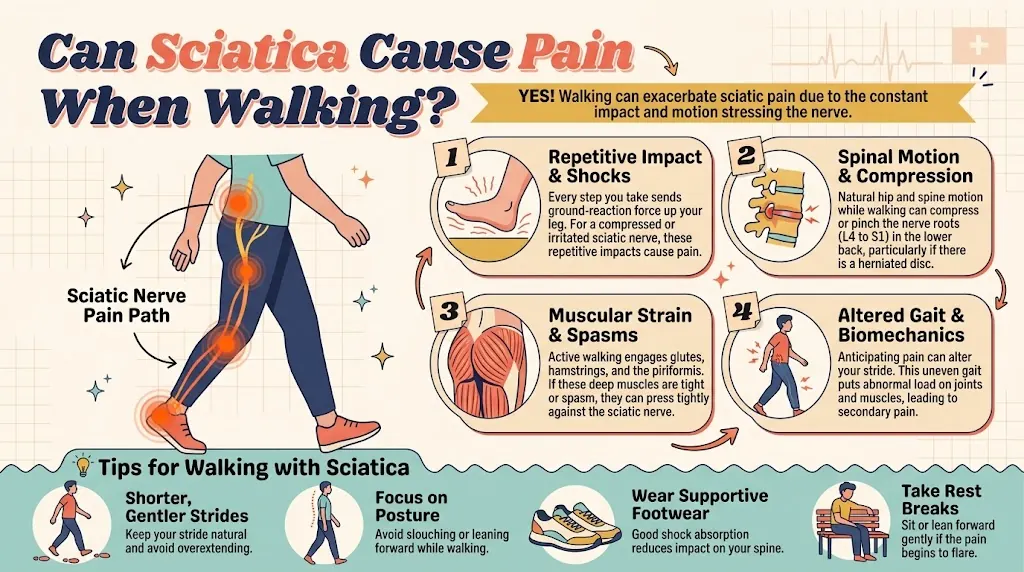
Try short, easy walks and change positions regularly rather than staying in bed for prolonged periods. If walking consistently increases leg or foot pain, shorten the distance, slow your pace, or take a break.
Read more about whether sciatica can cause pain when walking and how activity may affect symptoms.
2. Avoid positions that aggravate symptoms
Long periods of sitting, repeated bending, heavy lifting, or twisting may worsen symptoms in some people. You do not necessarily need to avoid these movements permanently; temporarily modify activities that clearly increase pain or tingling.
If sitting is a trigger, see why sciatica may hurt more when sitting and adjust your position or take regular movement breaks.
3. Use comfortable positioning and gentle exercise
A side-lying position with a pillow between your knees or lying on your back with a pillow beneath your knees may feel more comfortable. Gentle movement can be useful, but forceful hamstring stretches or nerve stretches may aggravate symptoms in some people.
For more guidance, explore how to sleep with sciatica and what to avoid doing during a sciatica flare-up.
4. Consider heat or cold for comfort
A wrapped cold pack or gentle heat may provide temporary relief, depending on what feels comfortable. Avoid applying extreme temperatures directly to the skin, especially if the affected foot is numb, because reduced sensation increases the risk of burns or cold injury.
If symptoms continue to interfere with walking or daily activities, ask a healthcare professional whether physical therapy, medication, or further evaluation is appropriate.
How Long Does Sciatica Foot Pain Last?
Sciatica-related foot pain may improve over several weeks, but recovery varies with the cause, severity, and whether nerve function is affected. Some people recover sooner, while persistent nerve compression can cause symptoms to last longer.
| Symptom pattern | What it may mean | Recommended response |
|---|---|---|
| Mild pain or tingling that is improving | Symptoms may be settling | Continue comfortable activity and monitor changes |
| Persistent foot pain or numbness | Ongoing nerve irritation or another condition | Arrange a clinical assessment |
| New or worsening weakness | Possible loss of nerve function | Seek prompt medical evaluation |
| Foot drop or rapidly progressing neurological symptoms | Potentially significant nerve dysfunction | Seek urgent assessment |
There is no reliable timeline based on foot pain alone. If symptoms persist for several weeks, interfere with walking, or fail to improve, discuss them with a healthcare professional. Persistent symptoms over months deserve reassessment rather than indefinite self-treatment.
For more information, see how long a herniated disc takes to heal and what can happen if sciatica goes untreated.
When Is Sciatica Foot Pain an Emergency?
Seek emergency care if you develop new difficulty controlling your bladder or bowels, cannot urinate normally, or experience numbness around the groin or inner thighs. These symptoms can indicate serious compression of spinal nerves.
New foot drop, rapidly worsening leg weakness, or difficulty lifting the front of your foot requires urgent medical assessment. Fever, severe pain after significant trauma, or a foot that suddenly becomes cold, pale, or blue also needs urgent evaluation because the cause may not be sciatica.
Pay attention to the first signs of sciatica, particularly if you develop numbness in the foot or tingling that travels down the leg. If you notice weakness in the leg from possible sciatica, do not assume it will resolve on its own.
Research-informed clinical guidance recommends staying active as tolerated, tailoring exercise to the individual, and avoiding routine imaging when there are no warning signs and the results would not change treatment. A clinician may recommend an MRI when symptoms or examination findings suggest that imaging would affect management.
Frequently Asked Questions
1. Can sciatica cause pain in just one foot?
Yes. Sciatica commonly affects one side of the body, and symptoms may be concentrated in the leg or foot. However, pain in one foot can also have local causes that need different treatment.
2. Can sciatica cause heel pain?
It can, although heel pain is not specific to sciatica. Plantar fasciitis, local nerve entrapment, and other foot conditions can cause similar discomfort.
3. Can sciatica cause calf pain and foot pain together?
Yes. Irritation of a nerve root may cause pain that travels through the buttock and calf into the foot. See how sciatica can cause calf pain.
4. Can sciatica cause hip and foot pain?
Yes. Symptoms may extend from the lower back or buttock through the hip and leg to the foot. Read about hip pain associated with sciatica.
5. Does sciatica always cause lower back pain?
No. Some people have leg or foot symptoms without noticeable back pain. The absence of back pain does not confirm or rule out nerve-root irritation.
6. Can sciatica cause buttock pain before foot pain starts?
It can. Symptoms may begin in the buttock and later extend down the leg, although the order and location vary. See buttock pain without leg pain.
7. Can sciatica make walking difficult?
Yes. Pain, numbness, or weakness may affect walking. New weakness or an inability to lift the foot needs urgent assessment.
8. Do you need an MRI for sciatica foot pain?
Not always. A clinician usually starts with your symptoms and a physical examination, reserving imaging for situations where it is likely to change treatment. An MRI may be appropriate for persistent symptoms or concerning neurological findings.
9. Can physical therapy help sciatica that reaches the foot?
Physical therapy may help improve movement, strength, and function, depending on the cause and your symptoms. A therapist can tailor exercises to your abilities and avoid movements that aggravate nerve symptoms. Learn whether physical therapy can help lower back pain.
10. When should you see a doctor for sciatica foot pain?
Arrange an appointment if pain persists, numbness continues, or symptoms interfere with daily activities. Seek urgent care for new weakness and emergency care for bladder or bowel dysfunction or numbness around the groin.
Conclusion
Sciatica can cause foot pain, tingling, numbness, and sometimes weakness when nerves in the lower spine are irritated. The exact symptoms vary, and foot pain alone cannot establish the diagnosis. Gentle activity may help, but persistent symptoms need evaluation, and new neurological changes should never be ignored.
Disclaimer: This article is provided for educational and informational purposes only.