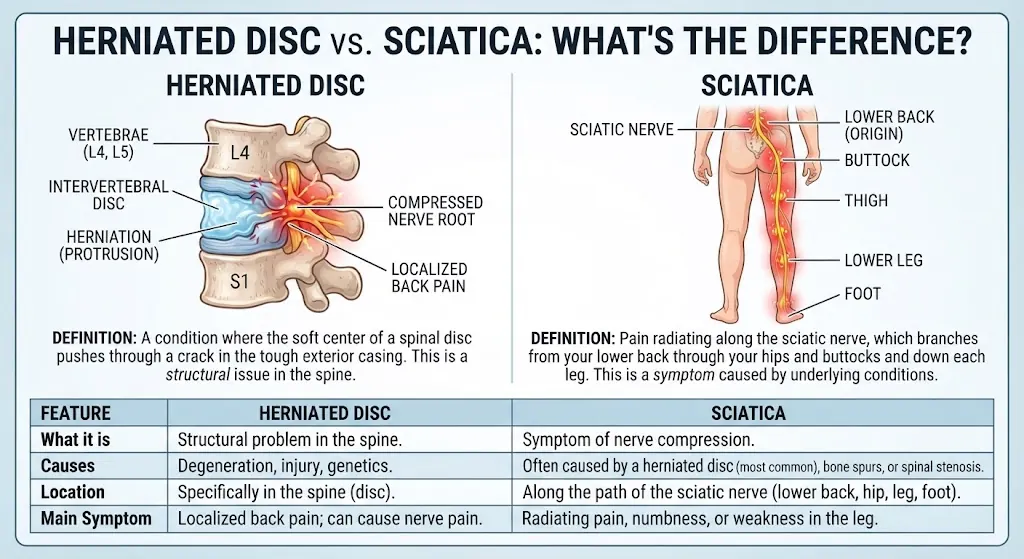
The main difference is that a herniated disc is a structural problem involving a spinal disc, while sciatica describes a pattern of pain associated with irritation of the sciatic nerve or its nerve roots. A herniated disc can cause sciatica, but sciatica can develop for other reasons, too. Having a herniated disc on an MRI does not automatically mean it is causing your symptoms.
Understanding the difference can help you make sense of your symptoms, know which tests may be useful, and understand what treatment might involve. This guide compares the causes, symptoms, diagnosis, treatment, recovery, and warning signs of both conditions.
What Is the Difference Between a Herniated Disc and Sciatica?
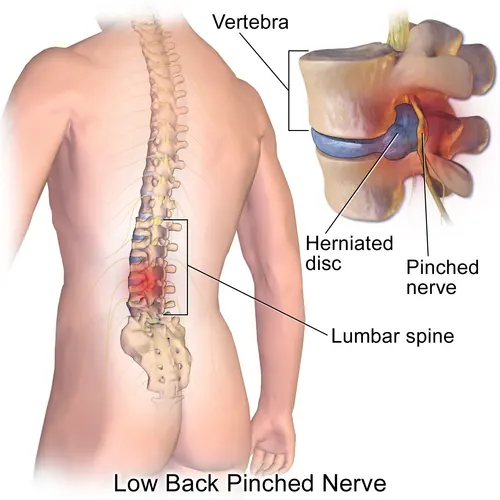
A herniated disc occurs when material from an intervertebral disc pushes through a weakened or damaged area of its outer layer. If the displaced material irritates a nearby nerve root, it can cause pain or neurological symptoms that travel into the buttock and leg.
Sciatica is not a specific structural diagnosis. It describes symptoms associated with irritation or compression of the sciatic nerve pathway, commonly producing pain that travels from the lower back or buttock into one leg.

Herniated disc
A spinal disc bulges or ruptures through its outer layer. It may cause local back pain, nerve irritation, or no symptoms at all.

Sciatica
Pain or other symptoms follow the sciatic nerve pathway. A herniated disc is one possible cause, but spinal narrowing and other sources of nerve irritation can also contribute.
In simple terms, a herniated disc describes what may be happening to a spinal disc, whereas sciatica describes how nerve-related symptoms may feel and where they travel.
Herniated Disc vs. Sciatica: Symptoms Compared
| Feature | Herniated disc | Sciatica |
|---|---|---|
| What it describes | A spinal disc abnormality | A nerve-related symptom pattern |
| Lower-back pain | Common, but not always present | May occur or be absent |
| Pain down one leg | Possible when a nerve is irritated | A characteristic symptom |
| Tingling or numbness | Possible with nerve involvement | May occur along the affected nerve pathway |
| Muscle weakness | Possible if nerve function is affected | Possible in more significant nerve involvement |
| Imaging findings | MRI may show disc herniation | Imaging may reveal a cause, but does not diagnose sciatica by itself |
| Treatment | Depends on symptoms and whether nerves are affected | Depends on the underlying cause and severity |
A person can have both conditions at the same time. However, a herniated disc can exist without sciatica, and sciatica can occur without a herniated disc.
Can a Herniated Disc Cause Sciatica?
Yes. A herniated disc in the lumbar spine can irritate or compress a nearby nerve root, producing sciatica. This can happen when disc material presses on a nerve or when inflammation around the nerve contributes to its sensitivity.
Symptoms may include lower-back pain, buttock pain, burning sensations, tingling, or pain traveling down the leg. The exact pattern depends on which nerve root is affected and how severely it is irritated.
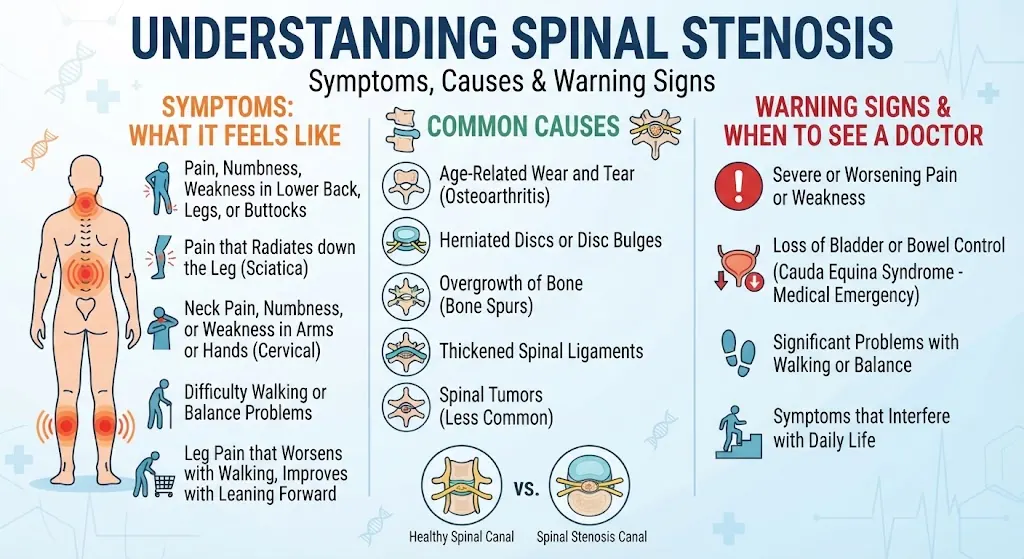
However, not every herniated disc causes nerve symptoms. Some people have a disc herniation visible on an MRI but experience no related pain. Conversely, sciatica may develop from spinal stenosis that narrows the space around spinal nerves or irritation elsewhere along the nerve pathway.
A useful distinction is that a bulging disc can also cause sciatica, but a bulging disc and a herniated disc are not exactly the same structural finding.
What does research say about herniated discs on MRI?
A 2015 systematic review of 33 studies involving 3,110 people without back pain found that signs of disc degeneration became more common with age. Estimated disc degeneration prevalence rose from 37% among asymptomatic 20-year-olds to 96% among asymptomatic 80-year-olds. Disc bulges also became more common, increasing from 30% to 84% across those age groups.
These findings matter because an abnormal MRI does not automatically identify the cause of pain. Clinicians need to compare imaging results with symptoms and examination findings before deciding whether a disc abnormality is clinically significant.
How Do Doctors Diagnose a Herniated Disc or Sciatica?
Diagnosis begins with your symptoms and a physical examination. A clinician may assess your walking, leg strength, sensation, reflexes, spinal movement, and whether certain movements reproduce your pain.
A straight-leg raise test may help identify nerve irritation in some people, but no single physical test confirms every case. Your clinician will also consider other possible causes, including hip conditions, peripheral nerve problems, and other spinal disorders.
An MRI may be appropriate when symptoms are severe or persistent, neurological findings are present, or imaging is likely to change treatment decisions. It is not routinely needed for every episode of uncomplicated back pain or sciatica.
If you are wondering what an MRI can show about lower-back pain, remember that scan findings must match the location and pattern of your symptoms. In selected cases, clinicians may also consider nerve conduction studies or electromyography to investigate nerve dysfunction.
How Are Herniated Discs and Sciatica Treated?
Treatment depends on symptom severity, functional limitations, neurological findings, and the underlying cause. Many people begin with nonsurgical care.
Nonsurgical treatment
-
Stay gently active: Continue comfortable daily activities rather than spending prolonged periods in bed. Reduce movements that repeatedly trigger severe pain.
-
Use individualized exercises: Walking, mobility work, and strengthening may help, depending on your symptoms. A physical therapist can adapt exercises to your condition.
-
Consider pain relief carefully: Over-the-counter medication may help some people, but risks vary. Ask a clinician or pharmacist about suitability, especially if you have other medical conditions or take other medicines.
-
Adjust aggravating activities: Break up long periods of sitting, avoid heavy lifting that worsens symptoms, and return to exercise gradually.
-
Consider physical therapy: A tailored program may help improve movement, function, and confidence with daily activities.
For practical guidance, explore how to relieve lower-back pain without medicine and whether physical therapy can help lower-back pain.
Treatment should be adjusted if an activity increases leg pain, numbness, or weakness. Avoid forceful stretching or spinal manipulation when the cause of symptoms has not been assessed and significant neurological symptoms are present.
When is surgery considered?
Surgery is not necessary for most people with a herniated disc or sciatica. A specialist may consider an operation when severe symptoms persist despite appropriate nonsurgical treatment, imaging matches the symptoms, or nerve function is threatened.
Procedures vary according to the cause. For example, a discectomy removes disc material that is compressing a nerve. The decision depends on potential benefits, risks, recovery needs, and the individual’s clinical findings.
How Long Does Recovery Take?
Recovery varies considerably. Some episodes improve over several weeks, while persistent nerve irritation can take longer. A disc may remain abnormal on imaging even after symptoms have improved.
| Situation | What recovery may involve | When to reassess |
|---|---|---|
| Mild symptoms without weakness | Gradual improvement with activity adjustments and self-care | If symptoms worsen or fail to improve |
| Persistent radiating leg pain | Clinical assessment and possibly physical therapy or additional testing | If pain limits daily activities or continues |
| New or progressive weakness | Prompt medical evaluation | Do not wait for a routine recovery period |
| Severe nerve compression or emergency symptoms | Urgent assessment and potentially specialized treatment | Seek emergency care when red flags are present |
For more detail, see how long a herniated disc takes to heal and what can happen if sciatica goes untreated.
Recovery should be judged by changes in pain, strength, sensation, and daily function—not solely by whether an imaging scan looks normal.
When Is a Herniated Disc or Sciatica an Emergency?
Most back pain and sciatica do not require emergency treatment, but certain symptoms can signal serious nerve compression or another urgent condition.
Seek emergency care immediately if you develop:
-
New inability to urinate or loss of bladder or bowel control.
-
Numbness around the groin, genitals, or inner thighs.
-
Severe or rapidly worsening weakness in one or both legs.
-
Severe back pain with new bladder, bowel, or saddle-area sensory changes.
These symptoms can indicate cauda equina syndrome, a medical emergency requiring immediate assessment.
Arrange prompt medical evaluation if you notice:
-
New or increasing leg numbness or weakness.
-
Persistent pain that disrupts sleep or everyday activities.
-
Back pain following significant trauma.
-
Fever or feeling seriously unwell alongside back pain.
Seek urgent assessment for concerning symptoms rather than assuming they are caused by a disc or sciatica.
For guidance on when back pain requires emergency care, consider the severity and combination of symptoms rather than pain intensity alone.
Frequently Asked Questions
1. Is a herniated disc worse than sciatica?
Neither is automatically worse. A herniated disc is a structural finding, while sciatica describes a symptom pattern; severity depends on pain, nerve function, and the underlying cause.
2. Can you have sciatica without a herniated disc?
Yes. Spinal stenosis and other conditions affecting the sciatic nerve or its nerve roots can cause sciatica. A clinician can help determine which explanation best fits your symptoms.
3. Can a herniated disc cause leg pain without back pain?
Yes. A herniated disc can irritate a nerve root and cause leg pain even when back pain is minimal or absent. See why a herniated disc can cause leg pain without back pain.
4. What does a herniated disc feel like?
Symptoms may include localized back pain, pain radiating into a leg, tingling, numbness, or weakness. Some herniated discs cause no symptoms at all; more detail is available in this guide to what a herniated disc feels like.
5. Does sciatica always mean a nerve is permanently damaged?
No. Sciatica does not automatically mean permanent nerve damage. Persistent or worsening weakness and numbness need medical assessment because prolonged or severe nerve compression can sometimes cause lasting problems.
6. Can a herniated disc heal without surgery?
Many people improve with nonsurgical care. Symptoms may settle as inflammation decreases and the body gradually reabsorbs some herniated material, although recovery varies.
7. Should I walk if I have a herniated disc or sciatica?
Comfortable walking is often reasonable if it does not significantly worsen symptoms. Start with manageable distances and adjust your activity if pain travels farther down the leg.
8. Should I rest in bed until sciatica goes away?
Prolonged bed rest is generally discouraged for uncomplicated back pain and sciatica. Short periods of rest may help during severe discomfort, but gradually resuming comfortable activity is usually preferable.
9. Can a herniated disc get worse over time?
Symptoms can fluctuate, and some herniations improve while others remain symptomatic. New weakness, progressive numbness, or significant changes in bladder or bowel function require prompt assessment.
10. When should I see a doctor for sciatica?
Arrange an evaluation if pain persists, repeatedly returns, limits normal activities, or causes ongoing numbness or weakness. Seek emergency care immediately for new bladder or bowel dysfunction, saddle-area numbness, or rapidly worsening significant weakness.
Conclusion
A herniated disc and sciatica are related but different: one describes a spinal disc abnormality, while the other describes a pattern of nerve-related symptoms. A herniated disc can cause sciatica, but not every disc herniation causes symptoms, and sciatica has other possible causes.
The most useful next step is to match your symptoms with a clinical examination rather than relying on pain location or MRI findings alone. Gentle activity and appropriate nonsurgical treatment may help, while progressive neurological symptoms or emergency warning signs require prompt medical attention.
Disclaimer: This article is provided for educational and informational purposes only.